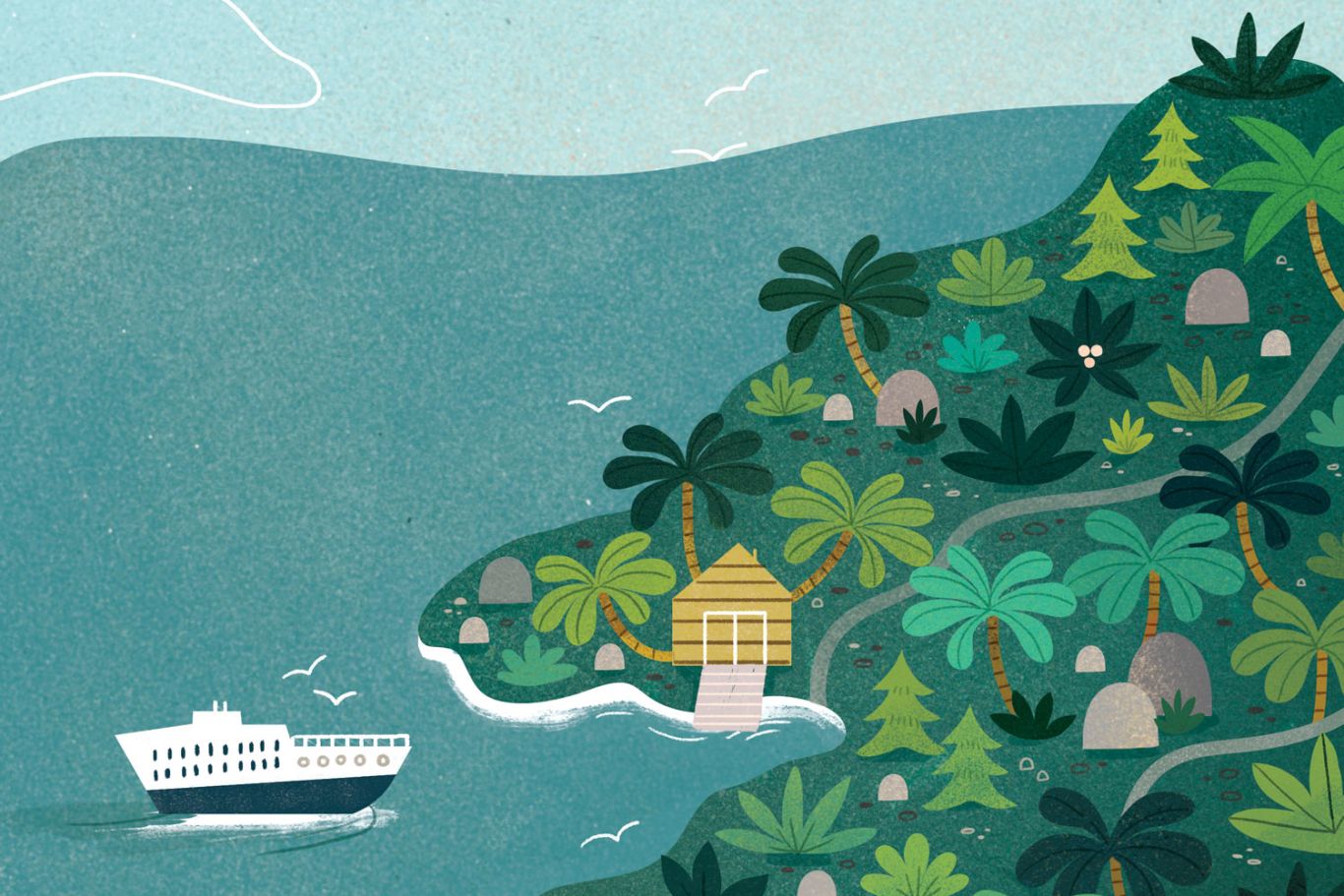
All alone in the middle of the ocean, the residents of Pitcairn Island have survived against the odds and have a remarkable story to tell.
Words by Craig Tansley, illustrations by Clare Owen
The VHF radio is blaring inside Heather Menzies’s hillside home – a cacophony of static and high-pitched gibberish.
“Steve… Steve," is all I can decipher, the rest is hollered in Pitkern, a blend of 18th-century mariner’s English and Tahitian – a language spoken nowhere else on Earth but here and Norfolk Island.
“What’s she want?" I ask Menzies. “Volunteers," she answers. “They’re taking long boats out. They need fish. There’s a cruise ship coming in the morning and the captain needs 100 kilos of wahoo."
And so I ride Menzies’s quad bike down Pitcairn Island’s steep red-mud roads to Adamstown, its tiny township, to watch the island spring to life.
Locals motor past me, serious-faced and purposeful, no time now for a cheery wave to this intruder: the first cruise ship to reach Pitcairn in three months will have much to trade. It’s German too, so there’ll be European ice-cream – creamy with exotic flavours – and smoked salmon, and maybe even caviar.
The menfolk launch longboats by hand in the swirling waters of Bounty Bay and steer their way through the tiny gap in the reef, just like their fathers, and their fathers before them have been doing for 225 years.
I watch the boats drift back and forth across that endless sea from Menzies’s home all afternoon. There seems no rhyme nor reason to the movement, and yet they’re back in hours with three times more fish than they need. Three hundred kilograms in an afternoon; mostly all wahoo too, like they know how to separate them from the fish Germans aren’t fussy for. “If there’s one thing Pitcairn Islanders know how to do, it’s catch fish," Menzies says with a proud sort of chuckle.
Next day, once the cruise boat sails on its merry way across the Pacific and 200 Germans have had their fill of gawking at the world’s most isolated and most bizarre community, they’ll dish out the spoils fair and square to all the households in this island of 43.
This is how life is on Pitcairn Island: where’s the good in filling your face if your neighbour goes without? Theoretically, you’d call it communism, but it’s communism that works (and has done for 225 years), devoid of evil tyrants (though the island might question that on occasion).
But then, life’s a little different when you live on a five-square-kilometre volcanic outcrop barely four kilometres long at its greatest length, that’s 6000 kilometres from the closest continent.
Roughly seven times more people will climb Mt Everest in a single year than visit Pitcairn Island. You can’t fly here, there’s not enough flat land for a bitumen road, let alone a runway, and ships must anchor out to sea and wait for Pitcairners in longboats to ferry them ashore.
Simply getting here is a major part of the attraction of visiting. It requires a journey of epic proportions in a millennia where modern transportation can deposit you in just about every other nook and cranny of the planet.
Even the discoverers of Pitcairn, the Bounty mutineers who sought the greatest refuge on Earth on which to evade the British forces who would surely come to hang them after they set their captain adrift in a lifeboat (he survived one of the most epic sea journeys of all time), took two months to find this speck of rock.
I’m flying from Papeete to Mangareva in French Polynesia’s far-flung Gambier archipelago, a four-hour propeller plane journey in itself. Here the New Zealand supply ship, MV Claymore II, sits at dock, ready for its three-day, two-night journey to Pitcairn Island. I will be one of only two tourists on this voyage.
With me is Pitcairn’s new governor (the British high commissioner to New Zealand), two US seismologists, a doctor, a marine biologist here to study the world’s largest marine park (830,000 square kilometres), and a member of the Travelers’ Century Club whose main prerogative is to visit all 195 countries on Earth before he shuffles off it.
I find my cabin; it’s rudimentary at best. There’s no bathroom and furnishings aren’t like those you expect on a modern cruise liner. But then, this is no pleasure craft, it’s a functioning supply ship, built for working crews, those whose stomachs can handle any sea (don’t expect the stabilisers you’ll find on the QE2).
I’m warned this will be an uncomfortable passage – five-metre seas will hit us front-on for nigh on 33 hours. But for those of us with the bottle it offers an opportunity to travel in the bridge of the ship with the captain and his crew, scanning the horizon for islands. Not that there’s any to see, just miles and miles of open sea, rising from within itself to dump white-water clean across our bow.
I spend my evenings in the crew’s mess eating as the world around me rises and falls as if I’m on an endless roller-coaster. When I’m done, I head to my room to read up on the world’s most isolated island.
Fletcher Christian and his fellow mutineers found Pitcairn Island on 15 January 1790. Christian chose the island after a seven-month journey through the South Pacific looking for safe haven, but finding nothing but hostile locals none too pleased by his trespass. In desperation, Christian considered Captain Cook’s unsuccessful search for Pitcairn Island (it was originally found by a Captain Carteret who was out by 3º when he mapped its location). When they finally came ashore, they scuttled the Bounty (in case it would be seen by passing ships), and hauled all they could muster up the Hill of Difficulty to form a township in what’s now known as Adamstown.
Within a decade, all but one of the mutineers would be dead. Christian himself was one of the first to go, murdered by the Tahitians he’d brought along (the mutineers had claimed most of the Tahitian women for themselves and treated the men like slaves). But the mutineers had time to sow their seed, and it’s their descendants who occupy the island today.
It’s these folk who come out to escort me ashore on the third day of my sea voyage. We’d anchored off the lee of the island, and within minutes a longboat of locals approached. No amount of travel adventures can prepare you for this liaison, for these mariners can’t be real but rather figments of our collective imaginations, the descendants of people represented only by Hollywood. Yet here they are, pulling up alongside the Claymore and screaming at me to come aboard.
When the swells underneath the ship reach their highest point, I’m passed from one deck to the next like a suitcase. And then I’m among them, these fantasy figures. They smile and they shake my hand, and while they’re certainly more weathered (their feet are so cracked some stitch the gaps together with thread), they seem no different to me. But when they shout at each other in the last frantic moments as we leave the ship behind, it’s in a language as foreign as anything I’ve heard.
Waves crash along the gnarled, rocky coastline as we motor towards Bounty Bay. Carteret couldn’t fathom going ashore when he discovered the island as he watched waves “which broke upon the shore with great violence". I wonder, too, how we’ll manage it, but negotiating these waters is in the blood of every Pitcairner, and I’m soon deposited at an old concrete dock and taken by quad bike inside a community none but a thousand or so outsiders have ever seen.
Oddly enough, it doesn’t take long to acclimatise to life on such a tiny island. I find myself content to do little but explore its creases and crevices, caring little for schedules: there are, after all, no restaurants, cafes, hotels or bars on the island.
Its only store is open for just two hours each Tuesday, Thursday and Sunday mornings (or until the last person leaves), but should you need something urgently you can always call. I soon look forward to these times. They’re the social highlight on Pitcairn Island, a time where every one of the island’s 40 or so inhabitants comes together to find out what they’ve missed out on.
For such a tiny strip of land, it’s easy to lose yourself. I traverse the muddy tracks that cut through the island – by quad bike and on foot – and stop at any walking track I see along the way. I’m guided down steep trails to a rugged coastline of black lava rock. I never quite know what I’ll find; some days I’m escorted to hidden bays where waves thunder onto craggy crops of fossilised coral, on others I find evidence of early Polynesian rock paintings over five centuries old that have never been seen by an anthropologist.
For a place surrounded by sea, there are very few places to swim on Pitcairn. Big Pool at St Paul’s Point is an enticing place to cool off when the waves settle down. It’s a natural rock pool beside the ocean, though any time I feel safe here from the elements a wave crashes its way over the top of the rock wall, reminding me just how much the sea governs everything on this tiny island. The water is impossibly clear (these are some of the clearest waters on the planet), and there’s never, ever a soul at any of the island’s known points of interest (though the only other tourist on the island is a 75-year-old American a few months shy of a knee replacement).
Alcohol was banned on Pitcairn till the 1990s under what was once a strict adherence to Seventh Day Adventist beliefs, but these days the emphasis is on socialising, little matter that the island has no bars.
I gather with local families (visitors to the island generally stay with locals in their homes) on outside verandahs most nights over cold beers as a cooling breeze blows through the banana trees, gaining insight into their bizarre private world. “I guess [living here] is a post-modern interpretation of the Robinson Crusoe thing," Menzies surmises one evening. “It’s like a microcosm of human nature, like watching Lord of the Flies in action. It’s not for the faint-hearted, it’ll test you. There’s been lots of tragedy on this island, it’s a monument to survival really, seven generations of survival."
I think about more recent upheavals too as I look down across the island from a rocky ridgeline one still evening. It was a little more than 10 years ago that six Pitcairners were found guilty of sex crimes that grabbed the world’s attention. There’s mystery here – buckets of it – though much has been done to ensure nothing of its kind ever happens again.
I soon find being here among the present-day community becomes far more fascinating than mixing with the ghosts of its much documented past. I become absorbed entirely in the unseen beauty of the island and the real-life soap opera playing out around me.
One night the whole island gathers in the old town square in Adamstown to welcome the new governor. I see them all together now – the old and infirm, the next generation, ageing surely and steadily – and I see the void in the years. There’s so few children left that it’s surely just a matter of time before this enigmatic society draws its last breath and the island returns again to nature.
On my last morning on Pitcairn, while researching the island’s website, I find a notice encouraging those ‘seeking a new life’ to move here. ‘Are you interested in the lifestyle on a small remote island?’ it ponders. There’s an email address to apply to immigrate. I wonder what kind of person might be genuinely interested, and if there’s enough of them out there to keep this place afloat.
And then I’m gone again, escorted to Bounty Bay ready to be driven out to the waiting Claymore. It’s with a surprising amount of melancholy that I say my farewells. I’ve been here just a few days, but leaving makes me sadder than I ought to be.
Something about this tiny community on the edge of the Earth has touched me: its nuances, the beauty that’s there once you scratch the surface. But most of all its people, a community of socially active hermits, globally connected but oh so geographically forsaken.
Details
How to get there
Fly to Tahiti via Auckland (airtahitinui.com.au), then board a weekly flight to Mangareva (airtahiti.aero).
The MV Claymore II (visitpitcairn.pn/go_there) sails at least twice every three months, on a Tuesday to connect with the flight.
Where to stay
Accommodation ranges from homestay experiences to self-contained cottages and holiday homes.
visitpitcairn.pn
Want to see more stories from International Traveller in your Google search results?
- Click here to set International Traveller as a preferred source.
- Tick the box next to "International Traveller". That's it.