hero media

Paradise found on Conflict Island, Papua New Guinea

International Traveller
The best way to witness the exotic world of Papua New Guinea is on a cruise to its eastern islands and a place of legendary beauty, Daniel Down almost finds.

You’re not going there too?

It was an incredibly unlikely coincidence that my father had booked a voyage to the exact same speck of land off the coast of Papua New Guinea that I was heading to on my own voyage just
three weeks later.

His admission didn’t detract from my excitement.

The start of a journey by ship holds a certain romance that you don’t get when travelling by plane or even train.

It harks back to a golden age of exploration, of sailing through dangerous waters to reach exotic cultures and lands of mythical beauty.

Leaving Cairns, passing through a channel carved through mangroves and chaperoned by a family of humpbacks, I felt the grip of adventure taking hold, even as I enjoyed the view from several storeys up on the teak deck of P&O Cruises’ Pacific Eden.

Just as my father had three weeks earlier, I was making my way to the wild land of Papua New Guinea, the closest country to Australia yet an unknown entity for many.

A cruise is perhaps now the easiest and safest way to see some of its many treasures; bypassing the capital Port Moresby, which has earned itself a dubious reputation.

“Beautiful, absolutely staggering… the colour of the water; the sand," my father had raved about the Conflict Islands on his triumphant return, carrying on like Rudyard Kipling with tales of some lost kingdom in the Far East.

And here I was now, watching the sun set on the Pacific, lulled by the gentle rocking of the massive ship cutting effortlessly through the ocean; and over that horizon, the Conflict Islands; my Shangri-La.

After a night exploring the ship and a lecture in the grand performance space on Papua’s tumultuous history of colonisation, we pull into Alotau, the port capital of the Milne Bay region in the country’s south-eastern tip.

It was a tent city of US and Australian troops during the war and the site of Japan’s first land defeat.

Today, it’s hot and humid and we’re whisked straight into the ramshackle, crumbling town that’s slowly being engulfed by the jungle.

At a cultural centre it’s not hard to see why the peoples of Papua New Guinea are described as being the most decorated on Earth as we watch displays of traditional dance from various tribes.

Orange contrasts with the inky black of a cassowary plume in the headdresses made from the feathers of birds of paradise.

There’s an ancient beauty to the performances; it’s perverse to think that this land of over 800 languages, the last heavily populated place on the planet to be explored, was ruled by Australia until it gained independence in 1975.

Later that day a long drive up the coast, crossing dilapidated bridges built by US troops, delivers us to a jetty.

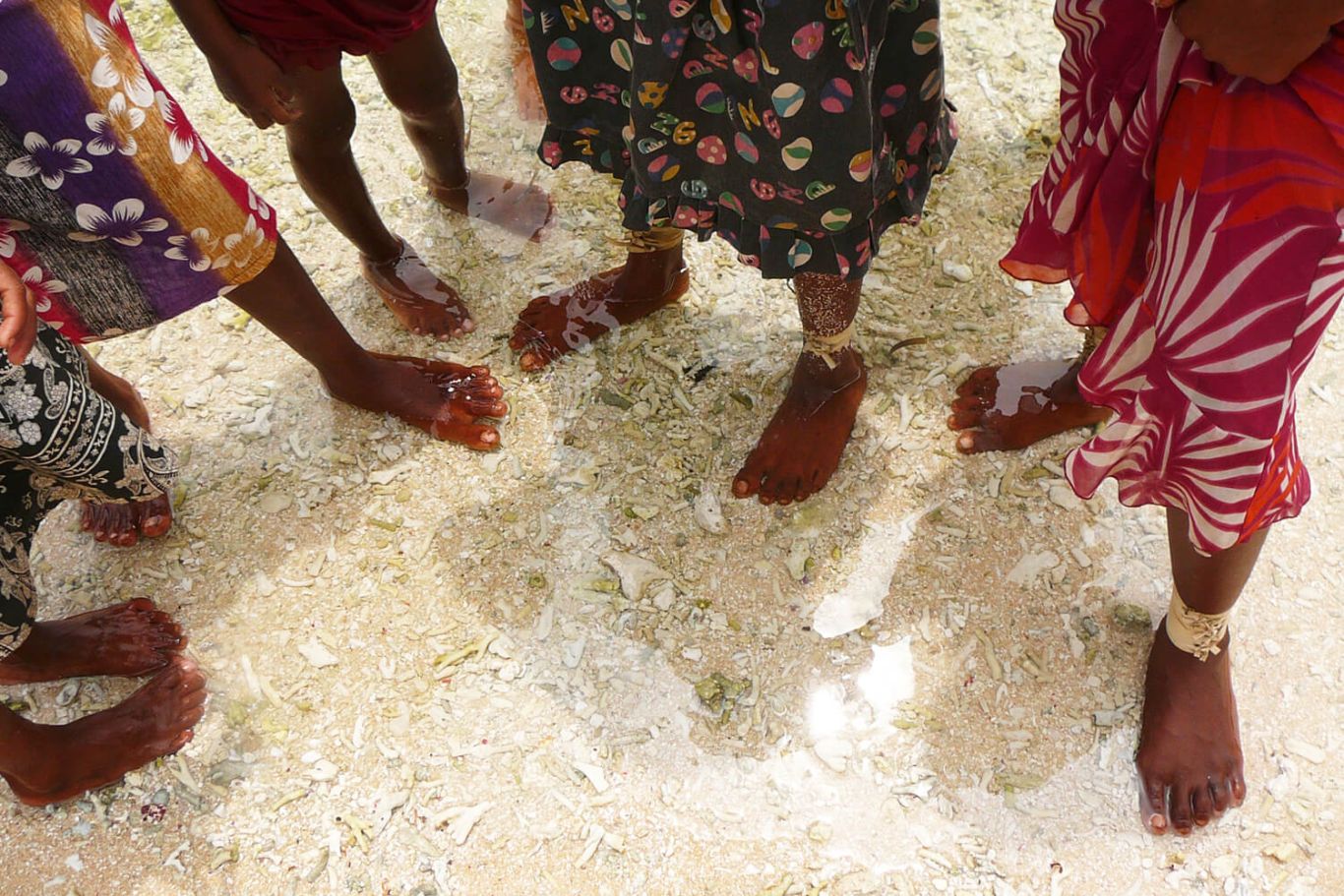
We catch a boat, cruising along the wild coast with our legs dangling over the side, and arrive at a cove that encapsulates how I imagined the country: a crescent of white sand bordered by rainforest-covered mountains, a pod of spinner dolphins joining us as local children run from a couple of beachside huts to paddle excitedly towards us in outrigger canoes.

The Pacific Eden carries us on an island hop towards our ultimate goal of the Conflicts, and the next two days are spent encountering the wonderful people of the Trobriand Islands: all betel nut-stained toothy smiles and a sincere desire to show you their small worlds; some have never set foot on the mainland.

On Kitava, the locals are ready with their carved offerings as well as outrigger sailing boats to ferry you across a 300-metre channel to tiny Nuratu Island where you can sit awhile under a palm tree, snorkel and walk its circumference.

On neighbouring Kiriwina, I feel I’ve stumbled on a peculiar anthropological mystery as a bizarre game of cricket gets underway in the beachside village of Kaibola.

One of my fellow passengers is in bat, while what seems to be all the young men of the village in traditional dress oppose him in front of a large crowd of locals, and what seems like all of the cruise ship passengers to boot.

The game can last for days, there are unlimited players on each team, and the army of fielders spontaneously breaks out into a kind of haka, perhaps a form of Papua New Guinean sledging.

I ask a weathered old man called Lucas – who seems to be the coach – how long the game has been played. “Over 100 years," he says.

Curiously, considering all the war-like posturing and elaborate dress of the men during the cricket, Kiriwina has a matriarchal society.

Women enjoy a higher status and I’m told by a boy who shows me his home that when a chief dies the title is passed onto the brother-in-law, thereby favouring the female strain of the family.

Next stop are the 21 islands that comprise the coral atoll of the Conflicts; in fact nothing to do with some Second World War battle – they were simply named by the captain of the HM survey ship The Conflict in 1886.

We’re steaming towards them, a perfect day; I’d soon be walking on pure white spits of sand, snorkelling over pristine reefs.

In fact there is an exclusive resort on the atoll, the entirety of which is owned by the unlikely eco-warrior, Ian Gowrie-Smith, who made millions developing mining and pharmaceutical companies among others.

He’s been at war with fishermen here who have been killing the turtles, going so far as to set their beach huts on fire.

Then the captain announces that the seas are too rough to let the tender boats ferry us to heaven, tantalisingly close though it is, and my father’s dreamy words of recollection come flooding back.

“The colour of the water; the sand!" I murmur through gritted teeth, staring at a white bar on the horizon.

And with that, the Conflicts remain a Shambala for me – a perfect place in my mind. And after all, it’s the getting there that counts.

Details

Getting There

– The nine-night P&O cruise departs from Cairns.

Playing there

– Fares start at $849 per person quad share for the New Guinea Island Encounter cruise departing 24 August, with calls to Alotau, Kitava Island, Rabaul, Kiriwina Island, Doini Island and the Conflict Islands.

Want to see more stories from International Traveller in your Google search results?

  1. Click here to set International Traveller as a preferred source.
  2. Tick the box next to "International Traveller". That's it.
hero media

5 things every hotel needs for a more restorative stay

    Kate Bettes Kate Bettes
    Wellbeing means different things to different travellers. Here’s how to pick a hotel that gets it right for you.

    The best wellness holidays aren’t necessarily spent wrapped in a spa robe. Sometimes they’re found around a dinner table in Cambodia, on a hiking trail in New Zealand or after finally beating jet lag on the other side of the world. The hotel you choose is what makes them happen.

    1. Easy access to good food

    meals from Novotel Bangkok Sukhumvit 20
    Taste delicious meals at Novotel Bangkok Sukhumvit 20.

    One of the quickest ways to derail healthy habits on holiday is to spend half of it working out where to eat instead of digging into the culture around you. Thankfully, Novotel has done much of the hard work already, with chefs building menus that lean into the flavours, ingredients and traditions of each destination.

    In Sihanoukville, Cambodia, Korkor soup – often dubbed ‘Cambodian ratatouille’ – sits alongside raw blue crab dressed with lime and chilli, best enjoyed with views across the Gulf of Thailand.

    In the lovingly chaotic city of Bangkok, the presence of food cranks up the sociability. At Novotel Bangkok Sukhumvit 20, you can settle in with mango sticky rice and stranger-turned-friends beside the pool at Sky on 20 rooftop bar, or bring them along to tackle river prawns and stir-fried crab with holy basil at the buzzing Crab Paradise Dinner Buffet.

    Then Novotel Dubai Al Barsha welcomes you with a laidback twist on the level of indulgence the Middle Eastern city is best known for up on Deck Se7en. Looking towards Burj Al Arab, the rooftop lounge has everything from Mediterranean-style dishes like seabass ceviche to Italian prosecco sundowners.

    At the other end of the scale, in the hills that surround the Novotel Bali Ubud Resort, calm comes from nature. At Siralada restaurant, Balinese traditions shape the menu while thunder rumbles over the surrounding jungle – proving the setting is as nourishing as the food itself.

    While at Novotel Nha Trang, chef Kieu Thi My Hanh and her team showcase Vietnam’s knack for balancing freshness, texture and fragrant herbs. Pho remains a favourite, while seafood salad with pomelo and mango brings those flavours together in one bright dish.

    It’s all an approach backed by partnerships with expert food creators such as Alfie Steiner, whose plant-forward recipes prove healthy food should never taste plain.

    2. Better sleep options

    Novotel Bali Ubud Resort room
    Sleep deeply with Novotel.

    There are few travel experiences more disappointing than arriving in a new country, determined to seize the day, only to fall asleep fully clothed by 3pm.

    For Australian travellers, jet lag is often an unavoidable part of the journey. That’s one reason Novotel runs sleep-focused initiatives that help guests adjust quickly without compromising on health. We’re talking partnerships with Sydney-based sleep specialist Olivia Arezzolo, known for her advice on everything from better sleep habits to beating jet lag, alongside features like pillow menus, in-room yoga content and tailored sleep guidance.

    The sooner you’re operating on local time, the sooner you can get back to more pressing matters – like deciding which spa treatment to book.

    3. More ways to move

    woman hiking around queenstown new zealand
    Stay at Novotel Queenstown Lakeside and explore local hiking trails. (Credit: GettyI mages/ naruedom)

    Every place in the world has its own way of getting you moving: whether that’s hiking up ice-bitten mountains before a sauna or gentle stretching by the pool before a facial. From fitness centres to spas, Novotel recognises that wellbeing rarely looks the same.

    At Novotel Queenstown Lakeside, activity is inescapable. Here, hiking trails, ski fields, bungee jumps, and white-water rafting have made the region famous. The hotel’s location on the shores of Lake Wakatipu means less time spent organising yourself and more time out there experiencing them. To top it all off, you can book a private hot tub for the evening before heading back into the wilderness tomorrow.

    Bali, of course, takes a softer approach. At Novotel Bali Ubud Resort or Novotel Bali Nusa Dua, movement is less about conquering a mountain and more about a dance class between the tropical gardens and lagoon pools. Afterwards, the spa takes over, with traditional treatments like a Lulur body scrub: a combination of rice, turmeric, sandalwood, ginger and jasmine that’ll soothe muscles already relaxed by the Balinese heat.

    4. Better connections

    Novotel Sharm El Sheikh
    Kids will love a stay at Novotel Sharm El Sheikh.

    One of the best things about travel is that it gives your family stories you’ll be telling for years. Novotel helps create them with activities that bring everyone together, whether that’s trying something new, learning a local skill, or simply spending more time together.

    Go for a distinctly Thai twist at Novotel Phuket Vintage Park, where many of the family activities draw on local culture. Kids can try everything from beginner Thai boxing and language lessons to umbrella painting and – a pastime beloved by children the world over – pool foam parties. Everyone is welcome to join in, whether that’s getting splashed, covered in paint, or simply watching their children discover a new side of Thailand during the dedicated Family & Kids Day.

    A different adventure awaits at Novotel Sharm El Sheikh. Kids could be perfectly content with discos, drawing classes and new holiday friends, but the Red Sea has other ideas. Sitting on the edge of Naama Bay, days here might involve snorkelling colourful reefs, taking a boat trip to Ras Mohammed National Park or heading into the desert by quad bike or camel for a Bedouin-style dinner beneath the stars.

    5. Location is everything

    Surin Beach, Choeng Thale, Thalang District, Phuket, Thaiföld
    Explore Phuket’s gorgeous beaches. (Credit: Bence Biczo)

    Everyone’s idea of wellness looks a little different. With more than 600 hotels across 65 countries, Novotel gives guests the freedom to choose the destination that suits them best. Whether that’s a beachside escape in Phuket, an alpine expedition in Queenstown or a city break in Bangkok, there’s a good chance a Novotel isn’t far away.

    All that’s left? Choosing your version of wellbeing.

    Discover stays to inspire your everyday at novotel.accor.com.