An authentic Thai town that hasn’t completely been overrun by tourism? One does exist. John Borthwick travels – almost to Laos – to find it.
Across the Mekong River the hunched blue hills of Laos fade and a firestorm dusk dials itself down to pitch-blackness.
The beer is cold and my fish, fried with ginger and garlic, is crisp, tangy and cheap. A few hours later I fall asleep in a classic, unrestored Indochine mansion.
Come morning in Chiang Khan, I awake to a hullabaloo of gossip and chanting monks in the street outside.
It could all be 100 years ago but it’s not.
This old river trading port in northeast Thailand has become the town that time remembered. Perched on the banks of the Mae Nam Khong (Mekong River), 580 kilometres north of Bangkok, Chiang Khan was until recently an unremarked settlement whose glory days — if any — of the rubber trade, opium smuggling, banditry and cross-river spats with colonial French or communist Laos, were well behind it.
Its original main road, Chai Khong, running parallel with the river, had been superseded by a newer, highway-facing town built just inland. Like a Mekong-moated Brigadoon, Chai Khong Road’s kilometre of century-old, two-storey teak shophouses was slipping into a picturesque decrepitude of subsiding stumps, rust and irrelevance.
And then the Janus-faced joker of tourism stumbled into town. Starting with a trickle of savvy Bangkokians in search of something more authentically Thai than mega-malls and traffic jams, the word spread that here was a piece of Thai heritage that still looked like itself — that hadn’t yet been slam-dunked with T-shirt stalls, night markets and kitsch.
“Yes, the town has much history," a local woman tells me, “but it is written in Thai. I can read, but have not."
It’s hard to get many hard facts about Chiang Khan, other than it has a handful of fine, old Buddhist temples; there is, perhaps, a population of around 10,000 people; and the town celebrated its centenary in 2009. Searching, I find a Thai language website that, having run itself through a translator app, describes the town with the sort of fantastic cut-up poetics that William S. Burroughs would applaud, and I can’t beat: “Chiang Khan, the beauty of diamonds coconut long glass, she was as silk to the island and curry source of culture."
By sheer luck I have booked online a riverfront room in a building that itself is history, a cache of period Siamese-Lao memory.
The manager of Loogmai Guesthouse, Khun Neng, tells me it was the first concrete building in town. She guesses it is “about 60 years old" (although I might add another 20 to that) and was built by Vietnamese craftsmen for a local Thai-Chinese-Lao family in the style of French Indochinese villas — two storeys, 20-centimetre teak plank flooring, archways, louvered shutters, high ceiling fans and a steep stairway leading from the ground floor trading area to family quarters above.
My upstairs room is an airy, whitewashed cube with a bed and no wardrobe, but perfect wi-fi. Very Thai. My view of the Mekong is interrupted only by the two Japanese backpackers on the porch who seem to wash their clothes for hours each day. I love this building.
Neng tells me, “Townspeople took shelter here when there were cannon attacks from Laos across the river because it was the only concrete house in town." I assume this is probably during the Pathet Lao rule of the late 1960s to early 1970s.
We scroll down fast on the timeline to when those savvy Bangkokians, seeking their version of sea-change/tree-change/me-change, started buying up the street’s old, Siam-era teak houses and then refurbished them into guesthouses, home stays, gift stores and cafés.
I arrived (by plane, taxi, bus and tuk-tuk) to find a town that stretches itself languorously along the Mekong’s south shore like a cat on a couch.
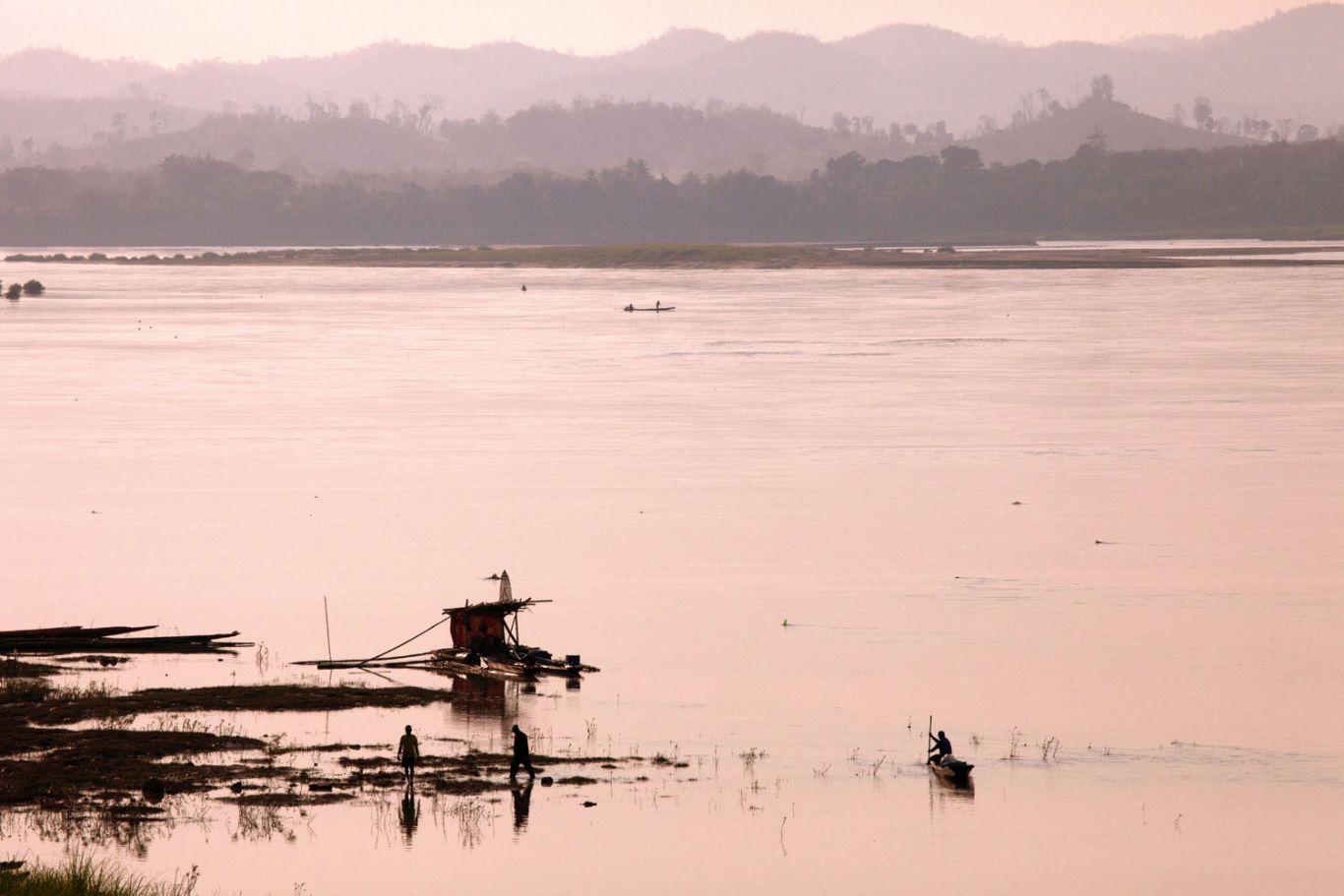
Sensibly, Chiang Khan’s citizens constructed a promenade long ago that runs the length of the old town along the riverbank – a great spot to stroll during lavish sunsets, the burning noon or occasional morning mists. On the river below, fishermen in pirogues net the eternal tides that slip past heading from Tibet to the South China Sea.
From the far bank I can hear Lao music – the zither-like khim or bouncy Isaan jigs — and see kids splashing on sandy river beaches.
Chiang Khan has boomed in the past four years, and even more so in the last two. It has well and truly been ‘discovered’ by urban Thais (although not by farang — I see fewer than a dozen foreigners a day), many of them drawn to a nostalgic past that they never had: Buddhist monks at dawn receiving alms and sticky rice, those rambling family homes made of ancient teak on streets of almost no vehicles, and local specialities like hand-sewn quilts and maphrao kaew (sugar-coated dried coconut) snacks.
What visitors don’t come here for is banana boats, go-go bars, day spas, botox clinics, ladyboys, muay thai boxing, bucket booze and elephant rides – just yet.
In lieu of all that, I have a simple choice to hire a bicycle (around $2 per day) or motorcycle (around $5 per day), view the Buddhist wats (temples), have a foot massage, or to simply stroll, read, eat and drink by the river… and visit a few more wats.
Or have a caffeine fix. Now, for all the cafés in town it’s hard to find a decent cup, but I don’t mind. Some of the most illuminating conversations I have here are with café owners.
On the trendy Soi Nine side-street off Chai Khong, two well-off escapees from Bangkok’s Big Mango Bar, husband-and-wife-team Em and Arm, tell me how they visited Chiang Khan 18 months ago, “fell in love" with the place, bought a run-down shophouse and transformed it into the See I 249 coffee and music shop, complete with macarons.
Farther east along Chai Khong Road — now designated paradoxically as both a cultural street and walking street — I drink at the Ganga Guesthouse, a beautifully restored teak structure that bristles with antiques and curios (plus the family SUV parked in the front room).
The middle-aged proprietors, also ex-Bangkokians, tell a story that is, as Thais like to joke, “same-same but different". Having settled here just four years ago in their quest for a quiet, creative retirement, they are already considering moving on due to, ironically, the changes that they were harbingers of.
Those changes now see the old, meandering, wooden, Mekong-side of Chai Khong Road transformed each evening into an open-air mall of trinket stalls, pirate DVDs and CDs, hawker snack carts and logo T-shirts (I love Chiang Khan, etc.). Quite literally, at times, I can’t see its teakwood for the T’s.
“I am afraid Chiang Khan is going to be the next Pai," a senior Buddhist monk told an earlier reporter, referring to the once-lovely northern Thailand town that has been overrun by night marketeers, tourists and investors, eviscerating its former essence.
And these shades of Pai, Pattaya and Patong are already appearing along Chai Khong Road too. The irony is that much of the tourist booty for sale here is no longer locally-made but mass-produced wares that visitors can buy in any Thai market from Chiang Mai to Bangkok to Koh Chang — just tweak the last word in the “I love (wherever)" tagline.
Some 619 out of 2317 vintage shophouses on Chai Khong Road and its adjacent alleys have been registered with the municipality’s architectural campaign. What degree of actual ‘protection’ this affords them is unclear. My own lodgings, Loogmai Guesthouse — worthy of national heritage list preservation — is about to be extensively redeveloped into something hip, chic, boutique and probably anodyne. Same-same not different, so to speak.
I hop on my bike and take a short ride on a cool morning, south along the river towards one of Chiang Khan’s main attractions, the Kaeng Khut Khu rapids. I’ve read that the shiny rocks here are supposed to be very beautiful.
Like me though, the writer didn’t actually see the reefs or their rapids because the water flow was too high. No worry.
Instead I get birdsong, an old wat, a bit of exercise, the endless river and not a souvenir stall in sight.
How to get there
Thai Airways, Emirates, QANTAS/Jetstar and British Airways have daily flights direct to Bangkok from various Australian ports.
Getting there from Bangkok
Chiang Khan, Loei Province, is 580 kilometres north of Bangkok and 50 kilometres north of Loei city.
Air: Nok Air (nokair.com) flies daily from Bangkok’s Don Muang Airport to Loei. Then take a bus from Loei bus station; Nakhonchai buses connect regularly to Chiang Khan, one hour away.
Bus: Take the bus from Mo Chit Northern Bus Terminal (nine-hour journey).
Train: Take the overnight train from Hua Lamphong station to Nong Khai, then a bus to Chiang Khan.
When to go
Chiang Khan is a year-round destination. The coldest (by Thai standards) months are December and January; the hottest are April through to June. Expect sporadic rain from May to November.
Where to Stay
Budget: Plearn Plearn Lodge on Chai Khong Road (with a river-view garden) is a small establishment above a gift shop, with budget rooms at around $20 per night. Contact Ms Nana at plearnplearn.chiangkhan@gmail.com
Comfortable: Dai Heng Boutique Hotel, also on Chai Khong Road, has river-view rooms from $50 per night and others for $33 per night; +66 42 822 228
Old Chiang Khan Boutique Hotel, similarly located, also has river-facing rooms from $50 per night; theoldchiangkhan.com
Upmarket: Chiang Khan Hill Resort (chiangkhanhill.com) and Chiangkhan River Mountain Resort (chiangkhanrivermountain.com) are both located on the banks of the Mekong River. Although they are situated a little out of town, they are much quieter and have superior facilities and grounds to any other accommodation in town.
Where to eat
Nang Len Len is a café-restaurant with seating right on the riverfront promenade. Try pla pad khun chai (fried fish with ginger and spring onions), and expect ice in your beer. Near Soi 16 Soi 9 Srichangkhan.
See I 249 Café, on trendy Soi 9 Srichangkhan, is great for Western or Thai breakfast, coffee and drinks – a friendly place with live music at night.
You can’t leave without
1. Hiring a bicycle and peddling out to Kaeng Khut Khu, four kilometres downstream of Chiang Khan. From February to May there may be rapids depending upon the Mekong’s flow. Locals picnic here on regional Isaan snacks like kung ten (dancing shrimp salad). On the opposite bank, the Laos PDR town of Xanakhan is an official crossing only for Lao and Thai citizens.
2. Rising at dawn to see monks from the local wats in procession down Chai Khong Road and receiving alms from kneeling Thais. (If you participate, place your offering in the monk’s bowl. A woman should never touch a monk.)
3. A driving excursion that takes in Ban Khok, 18 kilometres south of Chiang Khan, a cultural village of the distinctive Tai Dam minority; Phu Ruea National Park, 60 kilometres west of Loei with a 1365-metre summit; Chateau de Loei Winery (chateaudeloei.com); and Highway 211 that hugs the Mekong east to Nong Khai is among the most scenic drives in Thailand.
Best thing about Chiang Khan
The town’s authentic teak structures, a sense of the Isaan rural past (that’s disappearing rapidly elsewhere) and just hanging out beside the great river.
Worst thing about Chiang Khan
You have to handle the sad evidence of market-driven changes corroding the town’s previous authenticity. Thais acknowledge this but seem reluctant or powerless to actually confront and resist the tide.
You should know
English is not as widely spoken here as it is in tourist towns elsewhere, so speak slowly and clearly – and point to the menu.
There are numerous ATMs and several banks.
If you land at Loei airport, the taxi fare to Loei bus station is around $7; you might wait there until 3:00pm for the scheduled 2:00pm bus to Chiang Khan, but it does come, eventually. As all travellers soon learn to say, “TIT" – That Is Thailand.
Want to see more stories from International Traveller in your Google search results?
- Click here to set International Traveller as a preferred source.
- Tick the box next to "International Traveller". That's it.