I trialled Holafly eSIM in China and this is my verdict


The Laojun Mountain is one of many reasons to visit China. (Credit: Getty Images/ Zhang Mengyang)
Staying connected while travelling is more complicated in China, but is HolaFly the solution you’re looking for?
When I found myself unexpectedly travelling to China recently, almost my first thought was ‘How will I stay connected’ while I’m away? Having a phone in hand and the internet at our fingertips seems non-negotiable with travel now. God forbid the possibility of even temporarily being without that all-encompassing digital security blanket we’ve become so reliant on.
Questions rained down: how will I access the internet, how do I avoid surprise roaming fees, can I use my email account, and more.
Travelling to China made those questions more complicated. Say hello to the Great Firewall of China, an extensive system of controls that regulates (censors) internet activity within the country. That means many sites are banned, as well as many popular apps like WhatsApp, Instagram, Facebook and Google services, including Gmail. Two weeks without family chats and social media? What’s a modern girl supposed to do?
Options
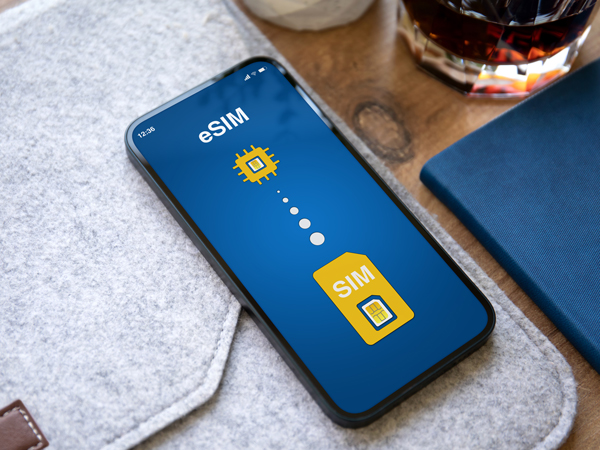
An eSIM is one a few ways to stay connected while travelling China. (Credit: Getty Images/ Prykhodov)
Apart from going cold turkey (really, anyone up for that?), here are your choices: rely on free wi-fi, buy a local SIM card, sign up for global roaming, download a reliable VPN (virtual private network) app to work around the firewall or get an eSIM. For access to your usual apps in China, you’ll need either of the last two options.
When Holafly, newly operating in Australia, offered me an eSIM to trial, it seemed like a good solution. What’s an eSIM, you ask? It works like a regular SIM but without the physical card. Instead, you buy an eSIM online for the country and duration you need, then load it onto your phone with the provided QR or activation code that’s emailed to you.
Different brands have varying pricing and data offerings, but the real advantage for me was that the Holafly eSIM comes with a built-in VPN. One less bit of technology to deal with, and reliable access to sites and apps otherwise blocked when using local connections in China.
Note: China restricts access to eSIM cards, which means they need to be purchased and loaded before you go.
Call me paranoid, but I also had cybersecurity front of mind, so I was pleased to totally avoid local wi-fi entirely and to use my own VPN instead.
Pros and cons
To use a Holafly eSIM, your phone must be both compatible and unlocked. Most newer phones are fine, but check on Holafly’s website for compatibility.
Pros
- Unlimited-style data plans – ideal for heavy users or anyone who doesn’t want to monitor gigabytes.
- Built-in VPN – this was the key benefit for me travelling to China, and it worked consistently throughout my trip and allowed access to all apps and sites I wanted.
- 500 MB of tethering – that’s the process of sharing your mobile data connection with other devices as a portable wi-fi hotspot. Handy if you’re travelling with multiple devices.
- Keep your own number – no need to swap SIMs.
Cons
- Fair Usage Policies apply – while the plans are marketed as unlimited, speeds may be reduced after extremely high use (I never reached that point), even if you can keep browsing.
- No local phone number – which means you can’t make local calls or send texts unless using data-based apps like WhatsApp. If making calls is important to you, this one’s not for you.
- A little pricier than basic eSIM options, but the VPN inclusion justifies it for China.
Installation and ease of use
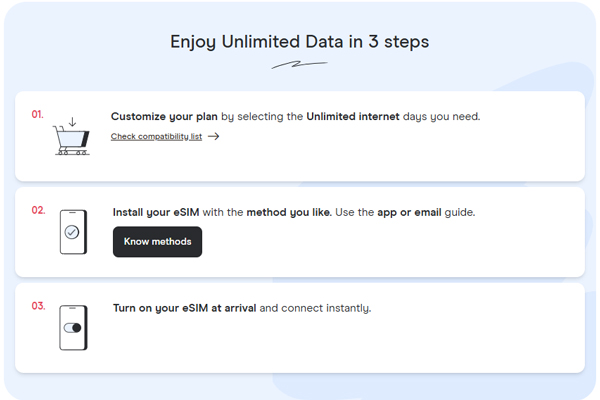
A screenshot of eSIM steps on Holafly’s website.
After purchasing, comprehensive step-by-step instructions are sent, designed for beginners, with a link to an explanatory video guide. Even though the video promises “all you have to do is click a button” to install, you actually have to press a hell of a lot more than that to follow the installation process.
While I admit I’m not the most tech-savvy person in the room, I found it confusing when the instructions didn’t align exactly with what my phone screen was showing, making me unsure whether everything was toggled on and off correctly in settings. You also need to make sure you toggle everything off correctly when you get home. It took me a week to work out why I was being left out of group messages.
Holafly’s companion app is basic but useful for checking instructions and contacting support.
Support
Holafly offers 24/7 support via online chat or messaging. It’s AI-driven, which means answers are competent but sometimes slow and repetitive. I tested it out on arrival in China to make sure I had everything set up correctly. I’m pleased to report I did. You can escalate to a human with some persistence. There’s email support as well, but no phone option. Multiple language choices are available.
Performance
Coverage across China was solid in my experience, using a mix of 5G and 3G depending on region. I usually saw download speeds in the mid-30 Mbps range, which was perfectly adequate for maps, messaging, browsing and video calls.
Holafly complies with General Data Protection Regulation (GDPR) and international regulations to keep user data secure, and provides end-to-end data encryption.
Pricing
Holafly offers flat-fee unlimited data for the number of days you need. Pricing varies by country and how long you need the eSIM for. The longer the package, the lower the daily cost. My plan for China was $79 for 15 days, about $5.30 a day, not the cheapest option on the market but similar to many global roaming plans.
Holafly offers eSIMs to over 200 destinations across Europe, Asia-Pacific, North America and South America. You can access their eSIMs through the company’s website and mobile app.
For frequent travellers, Holafly has just announced a new permanent eSIM with a monthly subscription (cancellable at any time) covering more than 160 countries.
Verdict
For China – or any country with restricted internet access – Holafly is a reliable, fuss-free way to stay connected to the apps and services you depend on, without dealing with separate VPNs or the risks of public wi-fi. It’s not the cheapest eSIM, but for simplicity, security and unlimited data, it worked well for me.
However you choose to keep connected on the go, if you’re travelling to a country with restrictions like China, make sure you’ve got it sorted before you leave home.













LEAVE YOUR COMMENT