How a pilgrimage through Bhutan’s mountains sparked a spiritual reset
Traversing cliffside monasteries, fertility temples and mountain fortresses, a journey through the Kingdom of Bhutan reveals a spirituality rich with joyful contradictions.
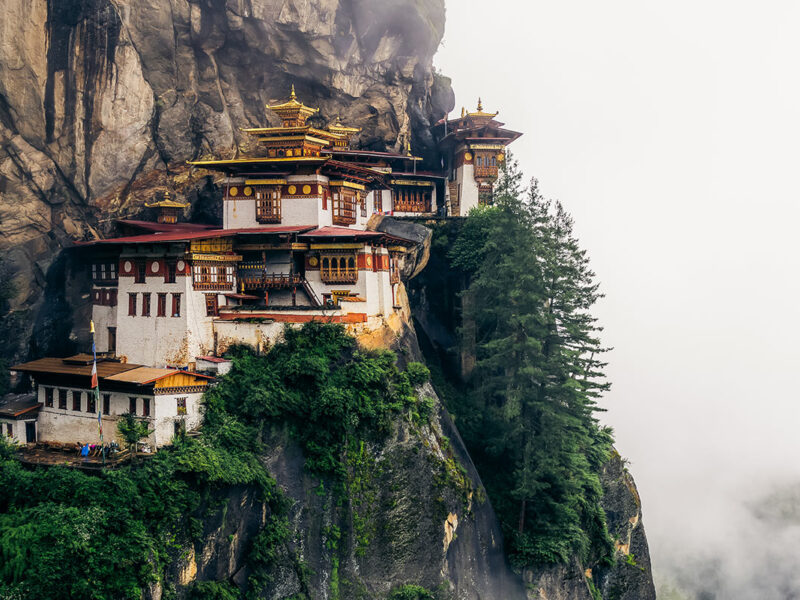
I’ve been trekking for hours, ascending through mist that curls around the mountain like tendrils of incense smoke. Breathless, I arrive at one of Bhutan’s holiest sites: Paro Taktsang, or Tiger’s Nest – a 17th-century monastery hewn directly into the Himalayan mountainside.
The sacred cave it’s built around has been a pilgrimage site since the 8th century, believed to be the birthplace of Vajrayana Buddhism in Bhutan. But when I step inside the monastery’s stone walls, awe gives way to fear.
Inside the sacred rituals of Tiger’s Nest monastery
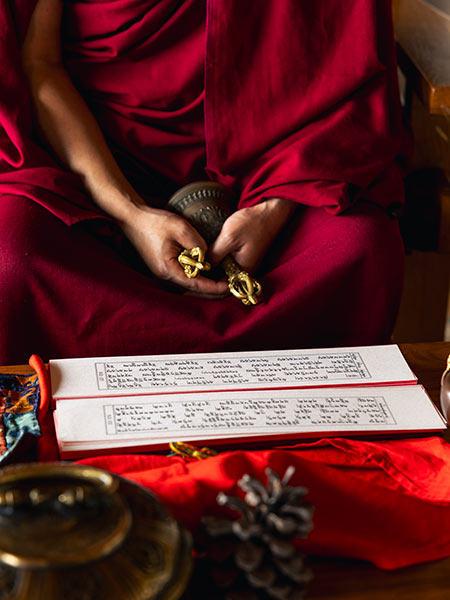
The Himalayan country is a whirl of colour as well as deep spirituality (Credit: Jeremy Zafiropoulos)
Inside, a prayer chamber hums with the low hypnotic drone of crimson-robed pilgrims chanting. Brilliant, psychedelic-coloured textiles hang from the ceiling, framing a statue of a wrathful deity at the centre of the room.
The figure, Dorje Drolo, is depicted with a ferocious snarl and three bulging eyes. It feels as though his gaze is fixed right on me. Every few minutes, the pilgrims raise a peculiar instrument to their lips and play a note in unison – a shrill, blood-curdling sound like a clarion call for the end of the world. I later learn the instrument is a kangling – a trumpet fashioned from a human femur.
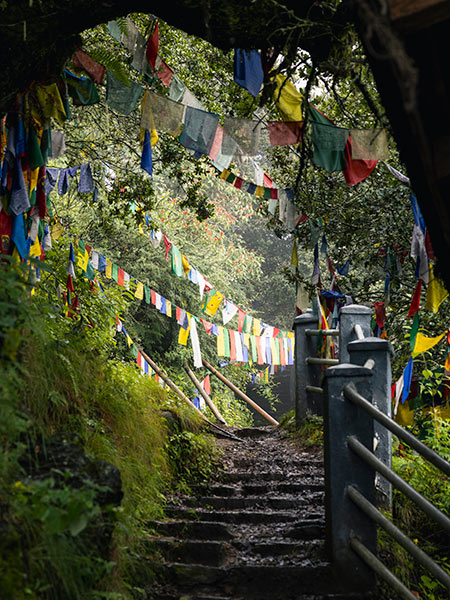
The hike up to Tiger’s Nest is decorated with prayer flags. (Credit: Jeremy Zafiropoulos)
“It is customary to pray three times,” my guide, Sangay Wangdi, tells me. “Copy me.” I do – prostrating myself before the wrathful figure, bowing until my forehead touches the cool, timber floor. The pilgrims are summoning wrathful spirits, Sangay explains, to appease and subdue them. Many have travelled from across Bhutan to recite 100,000 prayers – a ritual that can take weeks, even months, to complete.
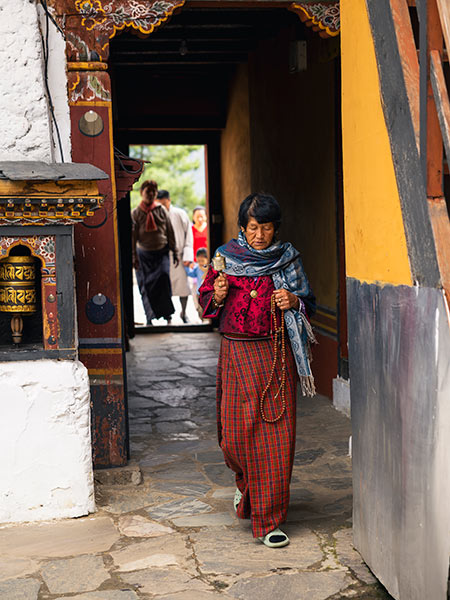
Deep prayer is part of the fabric of everyday life. (Credit: Jeremy Zafiropoulos)
We leave the monastery and begin the long hike back down the mountain. My nervous heart rate recovers as I inhale the resinous scent of the pine forest mixed with the sweet, peppery trace of incense drifting from above. As we descend, Sangay explains that the fear I felt at the monastery isn’t unusual.
Understanding Vajrayana Buddhism in Bhutan
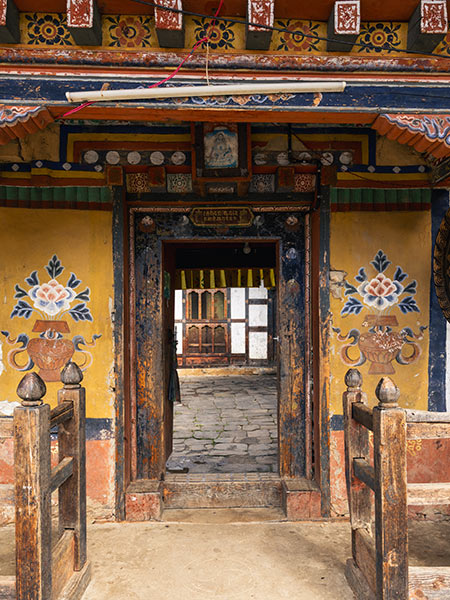
A small local temple in Bumthang. (Credit: Jeremy Zafiropoulos)
In Buddhism, summoning, acknowledging and appeasing wrathful spirits is a way of clearing obstacles on the path to enlightenment. “It’s like disciplining a child,” Sangay explains. “Not everyone responds to softness. Sometimes, you need to be shocked out of ignorance.”
Here in Bhutan – the world’s last independent bastion of Vajrayana Buddhism – things are inverted. Fear is sacred. Death is folded into life. And even sexuality is conceived of differently, with decorative phalluses commonly painted on dwellings and shopfronts, said to bring blessings to those inside.
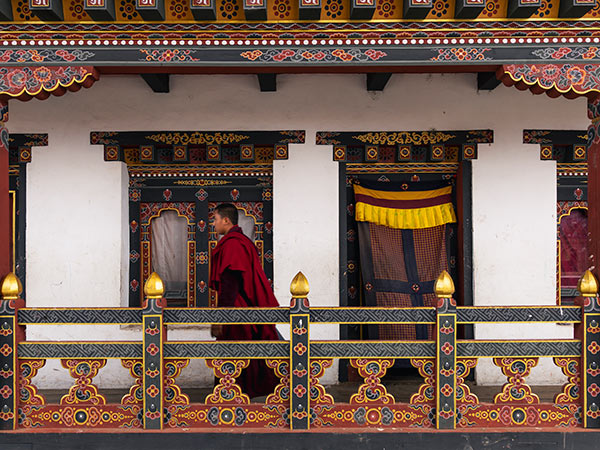
A monk in a stunning rural monastery. (Credit: Jeremy Zafiropoulos)
A stray dog with a chestnut coat ambles towards us as we walk. “In Buddhism, we believe dogs will be reincarnated as humans in the next life,” Sangay says. “That’s why they’re so friendly.” The little creature certainly seems affable, falling into step beside our group as we descend the mountain.
Recovering in luxury at Six Senses Paro
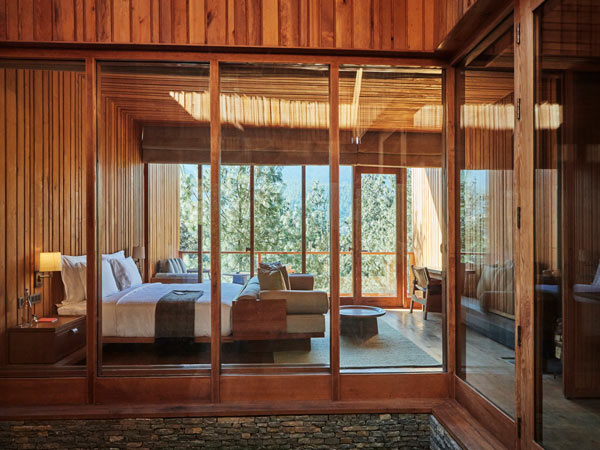
Six Senses Bumthang sits respectfully in nature. (Credit: Jeremy Zafiropoulos)
Returning to my luxury stay at Six Senses Paro is just the salve I need after the long day’s hike. When I arrive, the monastery neighbouring the resort is alive with chanting and the beating of drums – it’s a school for “kid monks”, Sangay tells me – and sure enough, the washing line out front is strung with little crimson robes.
The resort, which overlooks the Paro Valley, feels like the corporeal counterpart to the spiritual environment I’ve just encountered. Upon returning, I’m ushered into a quiet lounge, where a peppermint-oil foot massage eases my aching muscles. Later, in the spa, a singing bowl is placed upon my spine, with massage therapist Sonam drawing out its deep vibrations as she hums a protective chant for my spirit.
But the best restoration arrives at dinner. Bhutanese food is earthy and grounded, equal parts nourishing and delicious. Umami-rich bone broth, a local staple, arrives first. There’s nutty red rice, roasted Himalayan trout from the Haa Valley and plump house-made momos packed with juicy filling.
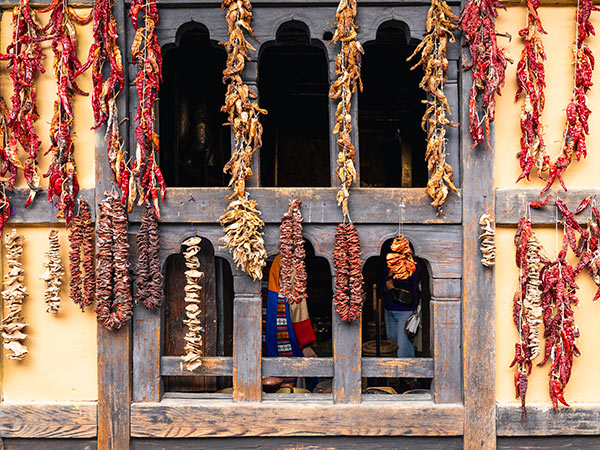
Drying chillies is a fixture of Bhutanese households. (Credit: Jeremy Zafiropoulos)
Best of all is the fiery chilli ezay, a Bhutanese speciality that’s served with everything. When I tell the chef how much I love it, she returns with a printed recipe and a packed jar for me to take home. It’s a small gesture that captures Bhutanese hospitality: warm, inviting and deeply generous.
Onboard for one of the world’s most difficult landings
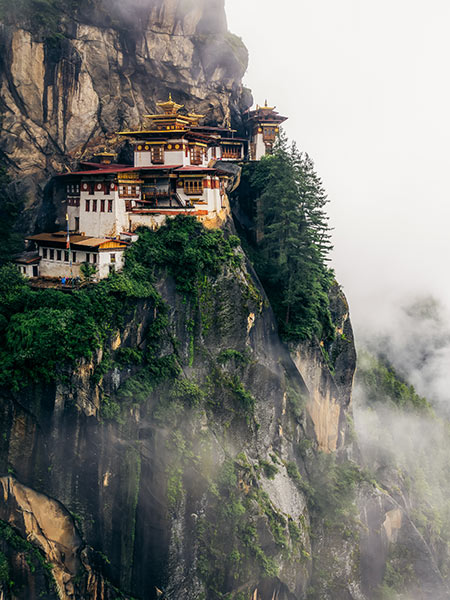
Sacred monastery Paro Taktsang (Tiger’s Nest) is perched on a mountain face. (Credit: Jeremy Zafiropoulos)
Bhutan is one of the most difficult countries to reach, due to its single international airport in Paro, considered among the most challenging landings in the world – there are only around 50 pilots certified to fly in and out. A second international airport is expected to open in 2029, alongside the development of a new experimental ‘Mindfulness City’ built around Bhutan’s ‘Gross National Happiness’ philosophy.
My introduction to Bhutan had begun from the air just a few days earlier. From the plane, I could already make out rainbow prayer banners on the ground below, so densely clustered they were visible from among the clouds. Our plane wove between steep Himalayan peaks, heading towards the sprawling Paro Valley cleaved by a twisting rope of milky blue river.
As we began our descent, the pilot came in over the speaker: “We’re going to attempt a landing,” he’d said, pausing. “If conditions don’t allow… well… we’ll see.” The cabin fell silent. But moments later, the wheels touched down smoothly and the tension dissolved just as quickly as it had formed.
Once I’m off the plane, Bhutan reveals its character immediately. Even the airport is covered in intricate, brightly coloured murals – a feature that’s repeated across temples, homes and public buildings everywhere in the country. These murals are layered with symbols within symbols: lotus flowers, animals and deities drawn from centuries of scripture and tradition. It would take a lifetime to understand them all. I have barely more than a week.
A guided tour of mountains and monasteries
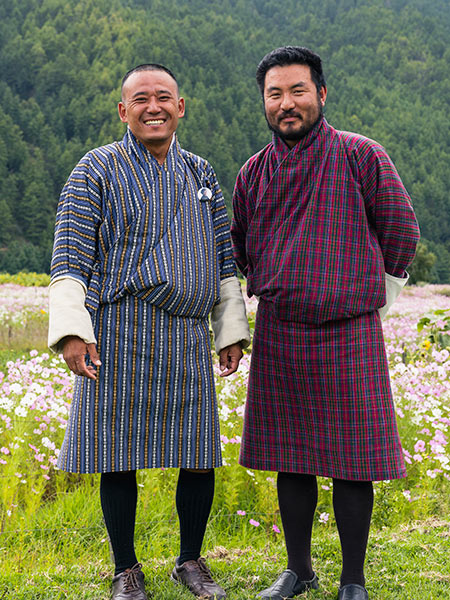
Friendly driver Namgay Dorji and knowledgeable guide Sangay Wangdi. (Credit: Jeremy Zafiropoulos)
As we drive deeper into the heart of the country, the road switchbacks and zig-zags while we scale mountains. But our perennially cheerful driver, Namgay Dorji, handles the ascent with practised ease. We pass golden rice paddies and fields flushed pink with Himalayan flowers.
The mountains here are so steep that if you were to trip, you would not fall, but simply drop. Nunneries and monasteries cling impossibly to the slopes, some appearing almost vertical. Every so often, we stop for cows wandering freely across the road, completely unbothered by the traffic. “They don’t even move for the king,” Sangay chuckles.
We’re heading for Bumthang, the spiritual and pastoral heart of Bhutan. Here, apple orchards dot the landscape and webs of prayer flags stretch across rivers. The air is fragrant with flowers, incense and wild hemp growing by the roadside, the wild scent carried by the breeze.
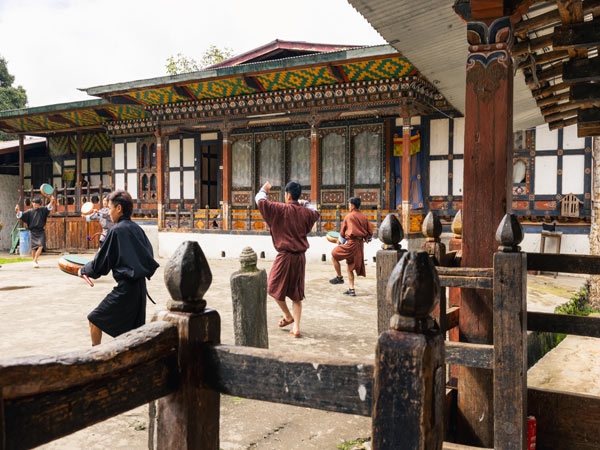
Villagers practise for an upcoming festival. (Credit: Jeremy Zafiropoulos)
This region is home to some of Bhutan’s oldest and most sacred sites, but the scene that leaves the deepest impression on me unfolds at a small local temple. We arrive just as villagers are rehearsing performances for an upcoming tsechu – a major religious masked festival.
Men gather in the temple courtyard, chanting and moving in rhythm as they beat hand-held drums, ceremonial drumsticks cutting arcs through the air. In another cloister, women practise traditional dances, their movements fluid and elegant as they perform to the low twang of a traditional Bhutanese lute.
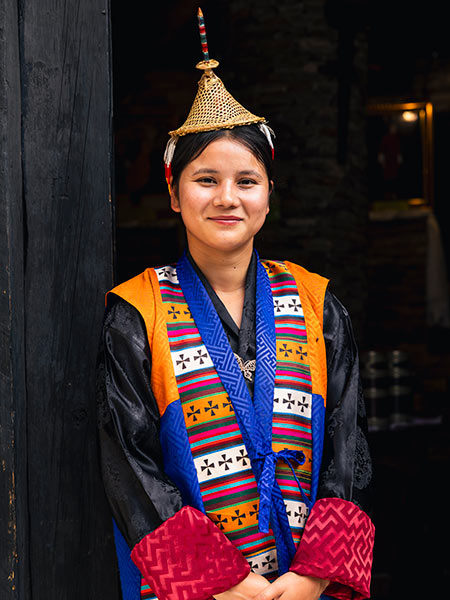
Technicoloured handwoven robes paired with pointed headwear are worn by the Indigenous Layap women. (Credit: Jeremy Zafiropoulos)
Everything in Bhutan is always turning. Elderly men and women circle stupas, twisting prayer wheels in their hands as they murmur mantras. Murders of crows wheel high above mountain monasteries and fortresses. And along temple walls, prayer wheels spin continuously, their bells chiming softly as they release prayers into the air.
After a day of exploring, I return to Six Senses Bumthang to find a traditional hot stone bath already prepared for me. In this traditional therapy, fire-heated river stones are lowered into water infused with locally gathered mugwort, a medicinal herb long used in Bhutanese healing practices. The heat is said to draw out the stone’s minerals, and I swear I can feel its benefits sinking deep into my skin.
A final glimpse of Bhutan’s unique spiritual traditions
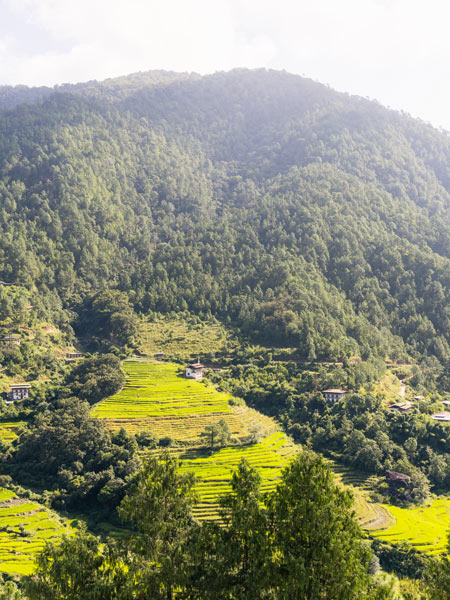
Verdant views in Punakha. (Credit: Jeremy Zafiropoulos)
Our journey ends in the Punakha Valley. It’s much lower and noticeably hotter here, almost tropical. I’m staying at the luxurious andBeyond Punakha River Lodge, where a handful of cabins dressed in gorgeous Bhutanese crafts are tucked along the riverbank. I can hear the roar of the river from the balcony, and I keep my eyes out for monkeys – known to make surprise appearances in the surrounding trees.
Many tourists and pilgrims travel to this region to visit the fertility temple, Chimi Lhakhang; its blessings believed to help couples conceive. As I walk towards it, I notice a woman who has made the pilgrimage.
She’s midway through a fertility ritual, having strapped an enormous bronze phallus to her back, and is encircling the temple three times. Inside, I find a book heavy with photos of babies and letters sent in from couples around the world, thanking the priests for helping them bring their children into the world.
Sangay explains this temple is dedicated to Drukpa Kunley, a 15th-century Buddhist saint known as the ‘Divine Madman’ who used humour and sexuality in his teachings to cut through spiritual ego. It’s a reminder of how multifaceted spirituality is in Bhutan: mystical, frightening, joyful, serious, irreverent and funny, all at once.
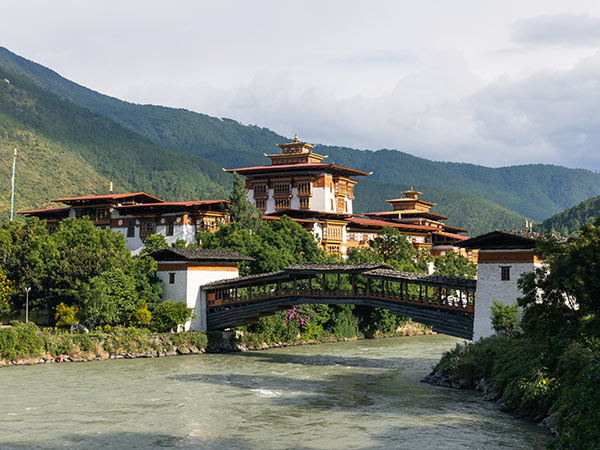
Punakha Dzong sits at the confluence of two mighty rivers. (Credit: Jeremy Zafiropoulos)
The last place we visit is Punakha Dzong at the confluence of two rivers. Inside, Sangay takes us through the intricate murals on the wall that detail the life of Buddha. “We all have a seed of Buddhahood within us,” he says. “It’s about how you nurture it. We believe that every animal has been our parent in one incarnation – and that we have been its child.”
Outside, a chicken squawks from the roof of the fortress, ruffling its feathers and flapping its little wings. My parent in a previous incarnation; my child in one to come. I believe it – Bhutan has shown me that reverence and sanctity live in the most unexpected of places.
Everything you need to know about visiting Bhutan
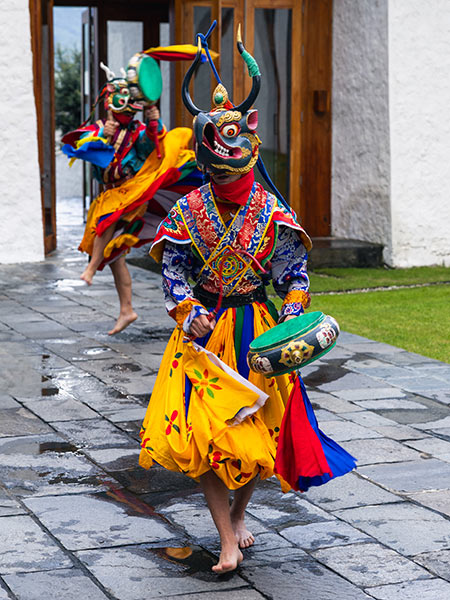
A masked dance performance at Amankora. (Credit: Jeremy Zafiropoulos)
Bhutan’s one international airport is in Paro. International flights operate exclusively with Bhutan Airlines or Drukair (Drukair also operate as DrukAsia, a tour company offering on-the-ground journeys in Bhutan), typically connecting via regional hubs such as Bangkok, Delhi and Kathmandu. A second international airport is slated to open in late 2029 as part of Bhutan’s Gelephu Mindfulness City project.
All foreign visitors must travel in Bhutan with a licensed guide. Arrange through a Bhutanese tour operator or directly via hotels, who can secure the required guide and driver for your itinerary. All tourists are required to pay a Sustainable Development Fee of US$100 per person, per night, which contributes to local sustainability initiatives.
Staying in Bhutan
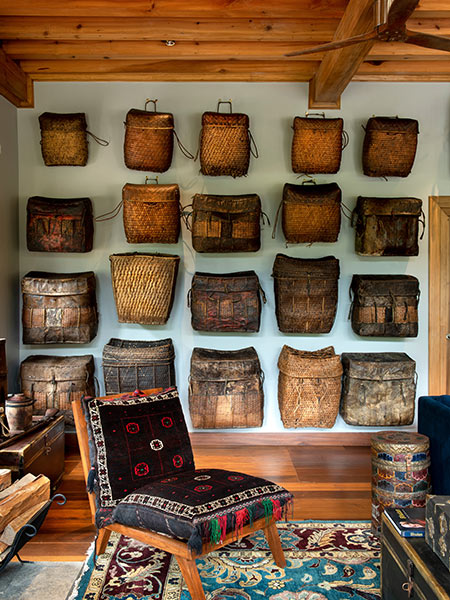
Crafts adorn the interiors at andBeyond’s Punakha River Lodge. (Credit: andBeyond Punakha River Lodge)
Bhutan’s luxury accommodation scene is dominated by three five-star hotel brands. Aman and Six Senses offer multiple stays throughout the country. The Amankora circuit and Six Senses Bhutan each comprise five lodges spread across the country’s main valleys – Paro, Thimphu, Punakha, Gangtey and Bumthang. Both properties are full-board. andBeyond Punakha River Lodge is a standalone luxury option in Punakha, known for its immersive, all-inclusive stay and curated ‘surprise’ experiences.


LEAVE YOUR COMMENT