
From medieval squares and mugs of Glühwein to silent discos and pumpkin glögg, these are the European Christmas markets worth travelling for.
There are very few things that makes standing outside in the freezing air seem like an excellent idea. One of them is skiing, and the other is Christmas markets. And where better than their birthplace for the former: Europe?
Nuremberg is one of the best Christmas markets in Europe for that classic German Christmas town feel, with red-and-white stalls, bratwurst, gingerbread, and a literal angel.
But travelling with kids? Copenhagen’s Tivoli Gardens brings the rides and spectacular lights, while Tallinn offers a smaller, cosier alternative for anyone easily overwhelmed by the crowds.
Whether you’re after the big names or somewhere a little different, here are ten of the best European Christmas markets to put on your winter itinerary.
Christkindelsmärik: Strasbourg, France
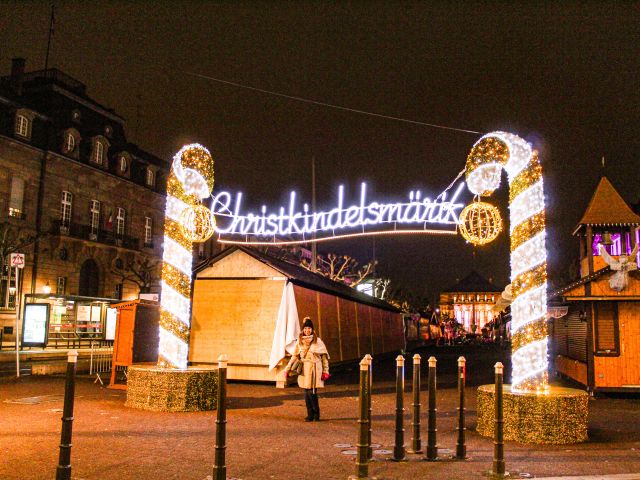
Best for: Old-school Disney lovers
Start with one of Europe’s oldest Christmas markets: Strasbourg’s Christkindelsmärik on the French-German border has been going strong since 1570.
Around 300 wooden chalets take over the historic Grande Île, spread across eight markets, from Place Broglie to the stalls beneath Strasbourg’s enormous Gothic cathedral. Beneath the 30-metre Christmas tree in Place Kléber, cups of vin chaud warm cold hands, while buttery bredle biscuits and bacon-and-onion-topped flammekueche are the perfect cold-weather fuel.
Traditional Alsatian ceramics make for cute, one-of-a-kind presents, while Marché OFF has upcycled gifts. Over at Village du Partage, the stalls raise money for charitable causes.
Don’t skip Petite France, whose half-timbered houses, canals, and Christmas lights will have you singing ‘Beauty and the Beast’ show tunes alongside ‘Douce Nuit’.
The 2026 markets run from 27 November to 24 December, daily from 11am to 9pm (2pm to 9pm on opening day and 11am to 6pm on Christmas Eve). The crowds can get thick, so aim for a Monday or Tuesday morning.
Admission: Free.
How to get there: The historic centre is a 10-minute walk from Strasbourg’s central railway station.
Old Town Square Christmas Market: Prague, Czech Republic
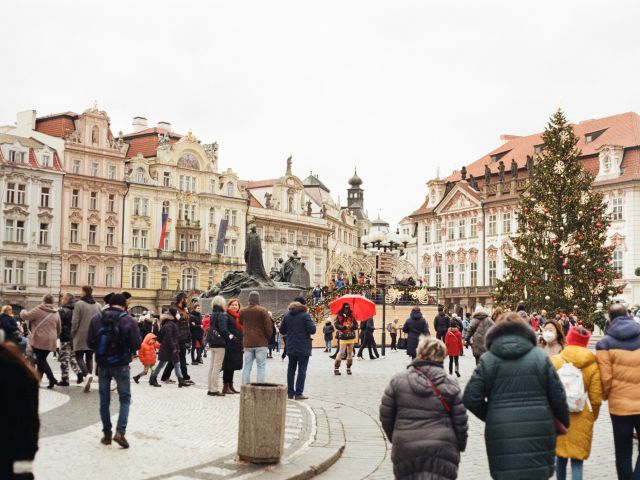
Best for: Gothic architecture fans
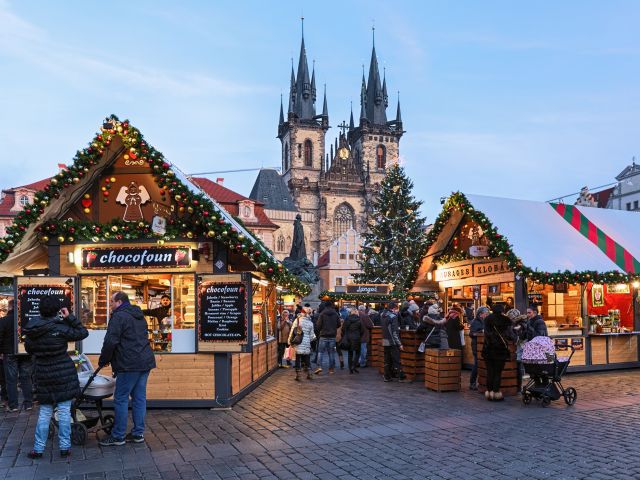
Next to the medieval astronomical clock with its famous animated figures, Prague’s Old Town Square (Staroměstské náměstí) hosts a Christmas market every Advent. Dozens of wooden stalls stand beneath the Gothic spires of the Church of Our Lady before Týn, alongside a 22-metre Christmas tree.
Wash down a slice of vánočka, a braided Christmas bread studded with raisins and almonds, with a cup of svařák (Czech mulled wine) or warm medovina (honey wine).
Among the stalls are hand-blown Bohemian glass ornaments, traditional wooden toys, and betlémy (nativity scenes). And if one Christmas market isn’t enough, head to nearby Wenceslas Square for another round of festive stalls.
The 2026 Old Town Square Christmas Market runs from 28 November to 6 January 2027 (Three Kings’ Day, or Epiphany), daily from 10am to 10pm.
Admission: Free.
How to get there: Prague Main Station is a 15-minute walk away.
Christmas Market Rathausplatz: Vienna, Austria
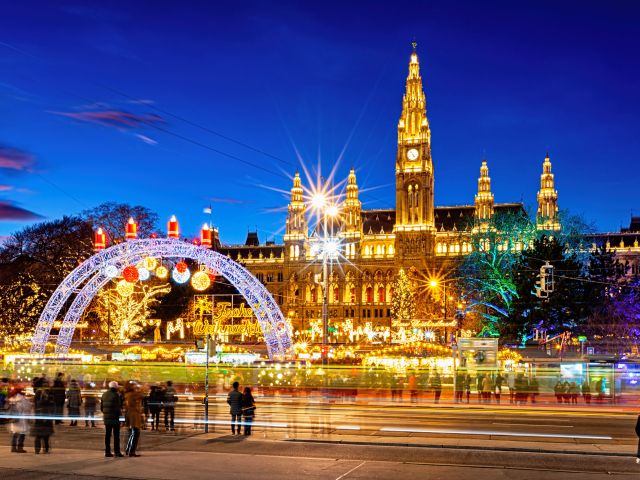
Best for: Old-world romantics
Vienna’s Christmas Market at Rathausplatz (or the Wiener Christkindlmarkt if your German is feeling up to the challenge) is smack bang in City Hall Square, with Gothic Revival City Hall as its super theatrical backdrop.
Armed with a glass of Weihnachtspunsch (Christmas punch), a cheese-filled Käsekrainer sausage, or a bag of hot maroni (chestnuts), revellers can make their way through the 96 stalls.
Look out for wooden nativity figures, hand-blown glass ornaments and that Viennese invention: the Schneekugel, AKA the snow globe. Brass bands play and choirs sing out as you check out the Tree of Hearts light display and lace up your skates for the ice rink.
Looking to Christmas Market-max? There are 20 official Advent markets – from the market outside Schönbrunn Palace to the artisan stalls along Spittelberg’s cobbled streets.
The 2026 Christmas Market at Rathausplatz runs from 13 November to 26 December, daily from 10am to 10pm (10am to 6.30pm on Christmas Eve).
Admission: Free.
How to get there: The Rathaus tram stop is right outside.
Nuremberg Christkindlesmarkt: Nuremberg, Germany
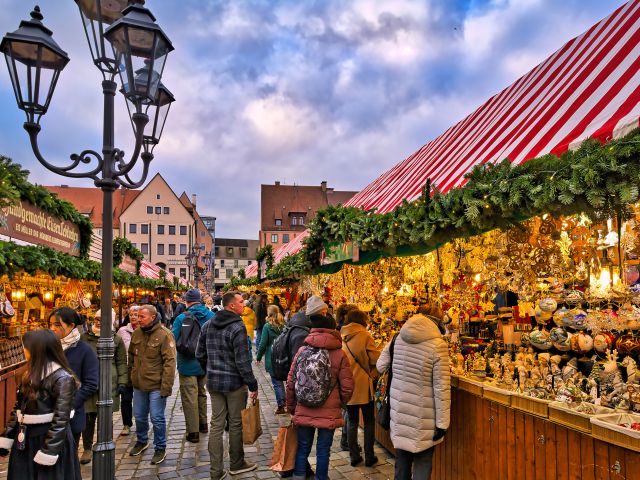
Best for: German Christmas purists
If you like your Christmas markets old-school, Nuremberg’s Christkindlesmarkt – thought to date back to 1530 – is hard to beat. Medieval Hauptmarkt is filled with around 180 wooden stalls with red-and-white striped roofs, all watched over by the Frauenkirche, on whose balcony the Christkind kicks off the festivities.
Try honeyed Lebkuchen (spiced gingerbread) from the ‘Witch’s House’ stall and Drei im Weggla: three little Nürnberger sausages in a brötchen. Wash it down with a mug of Feuerzangenbowle, mulled wine with rum-soaked sugar. Pick up Zwetschgenmännle, teeny figures made from prunes, figs, and nuts, and golden Rauschgoldengel angel decorations.
Take time out from the stalls to explore the Old Town’s medieval streets – I loved my leisurely wander round in Albrecht Dürer’s House.
The 2026 Christkindlesmarkt runs from 27 November (with the opening ceremony at 5.30pm) to 24 December, daily from 10am to 9pm (10am to 2pm on Christmas Eve).
Admission: Free.
How to get there: The market is a 15-minute walk from Nuremberg’s main railway station, which has connections to Munich, Frankfurt, and beyond.
Advent Basilica: Budapest, Hungary
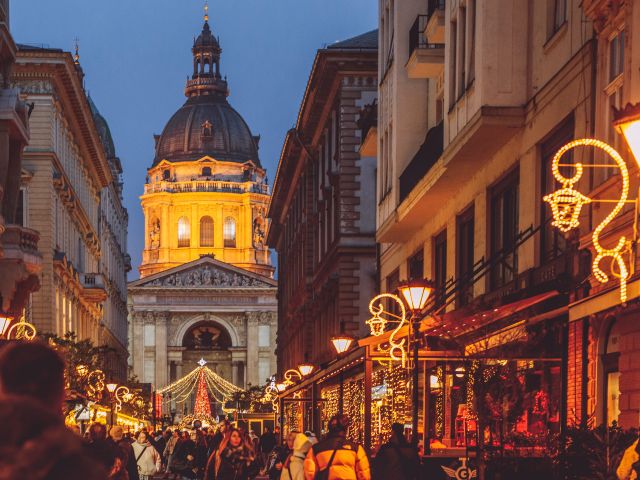
Best for: Light show fanatics
Budapest’s Advent Basilica (or Advent Bazilika) takes over Szent István tér, right in front of the Hungarian capital’s enormous St Stephen’s Basilica. Start with a glass of forralt bor (Hungarian mulled wine) while festive projections light up the church’s façade.
While you’ll find kürtőskalács (chimney cake) and lángos (fried flatbread topped with sour cream and cheese) at Christmas markets across much of Europe, it’s here you’ll find the Hungarian originals. Nearly 100 local exhibitors sell everything from hand-thrown pottery and Pécs leather gloves to jewellery. Look out for Tokaji sweet wines, too.
For a different view of Budapest, take an evening cruise along the Danube to see the city all lit up.
The 2026 market runs from 13 November to 1 January 2027, from 11am to 10pm Monday to Thursday and Sunday, and 11am to 11pm Friday and Saturday. It closes at 3pm on Christmas Eve but stays open on Christmas Day and Boxing Day, from 11am to 8pm.
Admission: Free.
How to get there: It’s a five-minute walk from Arany János utca metro station.
Advent on Zrinjevac: Zagreb, Croatia
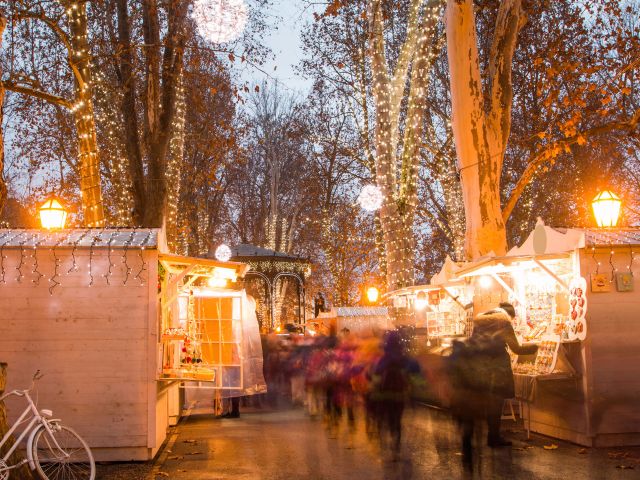
Best for: Christmas market veterans
Think you’ve seen every Christmas market trick in the book? Zagreb only joined the Advent party in 2014, but its Christmas celebrations were voted Europe’s best three years running.
Part of the citywide Advent Zagreb celebrations, the market fills tree-lined Zrinjevac Park with wooden stalls beneath Christmas lights, while choirs, bands, and DJs take over the central music pavilion.
Here, expect Croatian and Balkan specialities like sarma (meat-stuffed cabbage rolls), fritule (little Croatian doughnuts), and kuhano vino (mulled wine). Pick up a hand-painted licitar gingerbread heart as a souvenir. Don’t recognise half the dishes? All the more reason to try something you wouldn’t usually order.
The 2026 Advent on Zrinjevac runs from 29 November to 7 January 2027, from noon to 11pm Monday to Thursday, noon to midnight Friday, 10am to midnight Saturday, and 10am to 11pm Sunday. Christmas Eve hours are 11am to 5pm, and Christmas Day 5pm to 11pm.
Admission: Free.
How to get there: Zrinjevac Park is a short walk from Zagreb’s main railway station.
Christmas in Tivoli Gardens: Copenhagen, Denmark
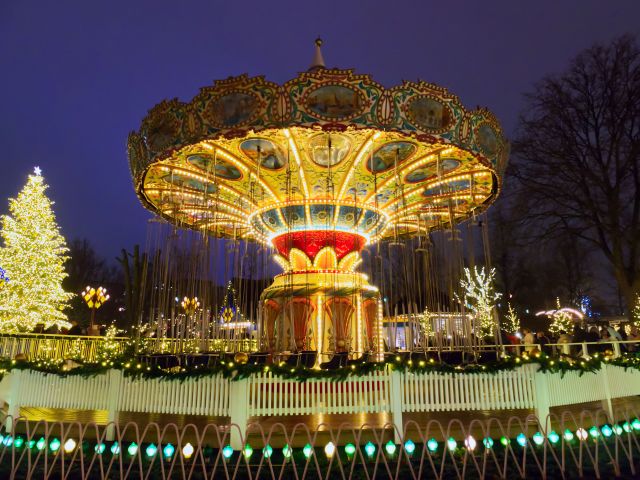
Best for: Big and little kids
Leave your German-style Christmas expectations outside the ornate iron archway – Copenhagen’s Tivoli Gardens goes all out for Jul i Tivoli (Christmas in Tivoli), with amusement rides, festive stalls, ballets, over a million lights, 50,000 baubles, and 1,000 Christmas trees.
Julemanden (the Danish Father Christmas) is helped by his mischievous nisser elves, whose little faces adorn Christmas decorations alongside traditional woven paper hearts (julehjerter). Kids can visit him, too – just check visiting hours to avoid tears. Hop aboard the Elf Train and check out the annual light projection shows.
After the rides – a bit risky doing it beforehand – try æbleskiver with jam and icing sugar, hot gløgg, and a flæskesteg roast pork sandwich.
Visiting on 13 December? Look out for the Santa Lucia parade, when candle-carrying choirs sing their way through the gardens. God Jul!
Christmas in Tivoli Gardens runs from 13 November 2026 to 3 January 2027, from 11am to 10pm Sunday to Thursday and 11am to 11pm Friday and Saturday. It’s closed on Christmas Eve but open from 11am to 11pm on Christmas Day, with New Year’s Eve hours extending to midnight.
Admission: Ticketed, with rides costing extra unless you buy a combined pass.
How to get there: It’s at Vesterbrogade 3, opposite Copenhagen Central Station.
Edinburgh’s Christmas: Edinburgh, Scotland
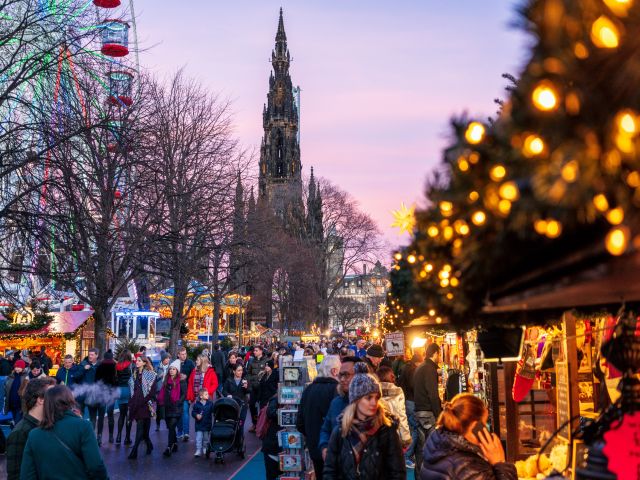
Best for: Christmas party people
The Fringe may have finished months ago, but Edinburgh never stops putting on a show – especially at Christmas. Edinburgh’s Christmas brings performances, parties, silent discos and fairground rides to the Scottish capital, while the main market fills East Princes Street Gardens beneath Edinburgh Castle.
Much of the food across the 70 stalls may be European-style – think bratwurst and Glühwein (hallo, Germany!) – but keep your nose out for Scottish tablet, shortbread, and a whisky hot toddy. Look out for bottles of Scottish whisky to gift, too.
Take in castle views from the Big Wheel, brave the 80-metre Starflyer, or visit the Viking-themed Polar Ice Bar, where even your glass is made of ice. And don’t miss La Clique cabaret.
Want to keep the party going? Hogmanay is just around the corner.
Edinburgh’s Christmas runs from 14 November 2026 to 3 January 2027, across East and West Princes Street Gardens and George Street. The main market opens daily except Christmas Day. Opening hours are 10am-10pm.
Admission: Free.
How to get there: Edinburgh Waverley Station is a 2-minute walk to East Princes Street Gardens.
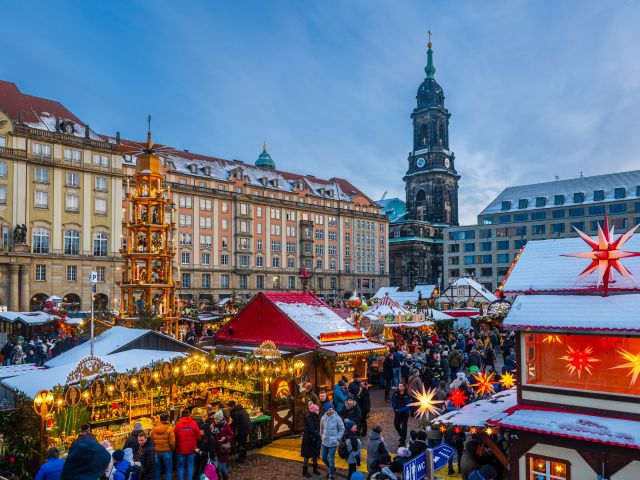
Dresdner Striezelmarkt: Dresden, Germany
Best for: Advent traditionalists
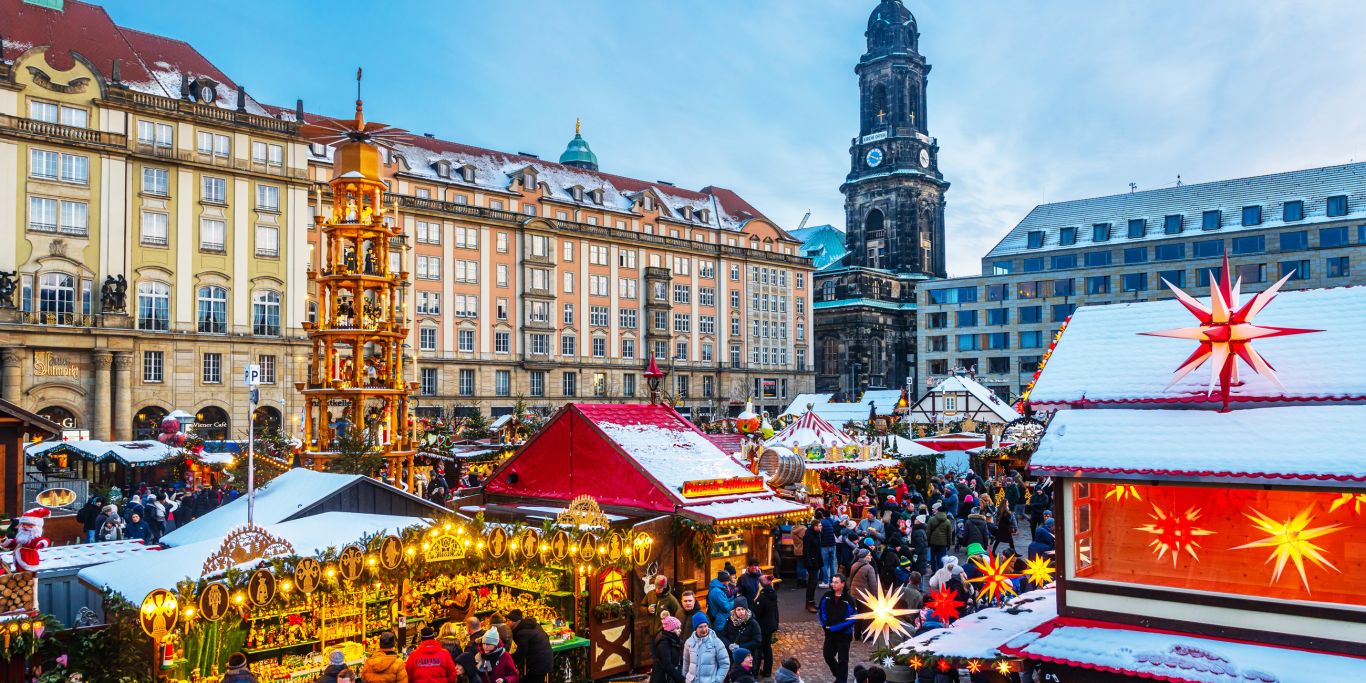
The city that loves its Christmas fruit bread so much it named a market after it. The Dresden Striezelmarkt takes its name from Striezel, an early name for the buttery, icing-sugar-dusted Stollen. And if that doesn’t take the cake, this Christmas market is Germany’s oldest – dating back to 1434.
It fills the Altmarkt with wooden stalls beneath a towering Christmas pyramid and an enormous illuminated candle arch. But the real stars are the wooden Christmas decorations from the nearby Ore Mountains. Look out for Schwibbogen (illuminated candle arches), Räuchermännchen (incense-smoking wooden figures), and traditional nutcrackers, all rooted in the region’s centuries-old woodcarving traditions.
As well as a mandatory slice of Dresdner Christstollen, try Pulsnitzer Pfefferkuchen (spiced gingerbread). Visiting on 5 December? Don’t miss the Stollenfest.
The 2026 Striezelmarkt runs from 25 November to 24 December at Altmarkt in Dresden’s Old Town. It opens from 4pm to 9pm on the first day, then 10am to 9pm daily (10am to 2pm on Christmas Eve). It’s closed on Christmas Day.
Admission: Free.
How to get there: 15-minute walk from the Dresden main station.
Weekly travel news, experiences
insider tips, offers, and more.
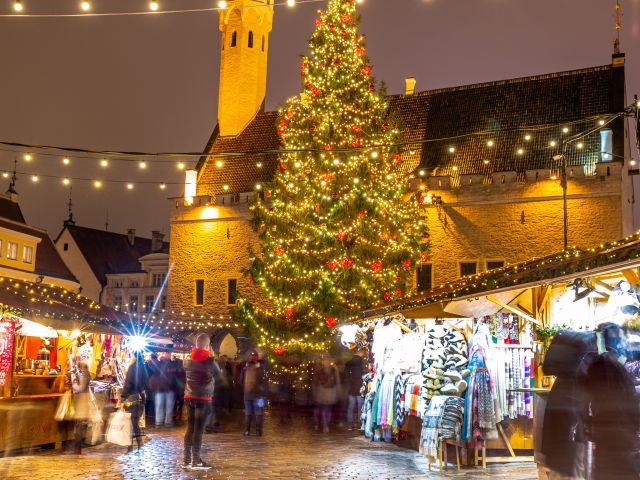
Tallinn Christmas Market: Tallinn, Estonia
Best for: Christmas craft fans
Less sprawling and more cosy, Tallinna Jõuluturg fills the cobbled Town Hall Square (Raekoja plats) in Tallinn’s UNESCO-listed Old Town with wooden stalls beneath its Gothic Town Hall. And Tallinn knows a thing or two about Christmas trees – the tradition of putting one up in the square is said to date back to 1441.
The stars here are Estonia’s own craftspeople selling patterned woollen mittens and knitted socks. Come hungry for verivorst (blood sausage) with sauerkraut, followed by piparkoogid (spiced gingerbread biscuits). Forget Glühwein: Tallinn goes big on glögg, with cranberry-cherry, raspberry-blackcurrant, and even pumpkin varieties. Yes, pumpkin.
Santa has his own little cottage, kids can hop on the carousel, and folk dancers and musicians take to the stage on weekends. Don’t leave without a wander through the Old Town’s Christmas-lit medieval streets.
Top tip you might not expect? After dark (or when there is poor visibility), pedestrians need to wear a luminous reflector (‘helkur’) on their clothes. Grab one at the supermarket.
The 2026 Tallinn Christmas Market runs from 20 November to 6 January 2027 at Town Hall Square, daily from 10am to 8pm (though hot drinks are served until 10pm, and 11pm on Fridays and Saturdays).
Admission: Free.
How to get there: Tallinn Railway Station is a 15-minute walk away.
When is the best time to visit Europe’s Christmas markets?
So, when do Christmas markets open in Europe? Late November to mid-December is generally the best time to visit Europe’s Christmas markets. You’ll catch the Advent festivities in full swing, before the Christmas week closures begin. Weekdays are usually quieter than weekends, especially if you visit earlier in the day.
Check each market’s dates before booking. Many close on Christmas Eve or Christmas Day, depending on local Christmas traditions, while others continue into the New Year. And although snow makes for a lovely pic, it’s never guaranteed (an overdose of cheesy Spätzle noodles, on the other hand, is).
How to plan a European Christmas market trip
If you’re flying all that way, you’ll want to make sure you’ve done all the planning necessary to making the trip as magical as possible.
How can I visit more than one Christmas market?
Want to squeeze two Christmas markets into one trip? Prague and Dresden are an easy pairing, with direct trains taking around 2–2.5 hours between the cities. You can even throw in Berlin’s markets, making the whole Berlin–Dresden–Prague journey around four hours by train.
Vienna and Budapest are just as convenient, with regular direct trains taking around 2.5 hours.
For a lengthier Christmas market adventure, try Prague–Dresden–Nuremberg. The Dresden–Nuremberg leg is roughly 3.5 hours by train, usually with a change. Book a seat at a table if you want to spend the journey having a Stollen feast.
Budgeting for Christmas markets
As you might expect, Christmas market city breaks bring a spike in prices, from train fares to hotels.
When deciding where to stay for Christmas markets, remember that being close to the Old Town is cuter, but usually more expensive, so work out what matters most to you.
So book accommodation and train tickets early, especially if you’re travelling over a weekend or planning to visit several cities.
Food costs can also add up, especially somewhere like Edinburgh, although a cup of Glühwein and a bratwurst remain relatively affordable on the continent.
You might get more food for the same money at a restaurant, but where’s the fun in that? A great middle ground is to share dishes at the markets to try a wider range without spending a fortune.
What to wear to Christmas markets?
Temperatures can plunge well below freezing outside, then feel positively steamy when you duck into a bar. Layer up with hats, scarves and thermals you can easily peel off.
Entry fees, cash and mug deposits
Most Christmas markets are free to enter, with Tivoli Gardens a notable exception, but it’s worth keeping cash handy, especially in Germany, where you’d be surprised how many stalls are still cash-only.
You’ll also need some change for the Pfand, or mug deposit, charged on mugs for hot drinks at many markets. Return the mug to get your deposit back, or keep it as a souvenir and forgo the money. It’s totally fine.
(Or, that’s what I tell myself whenever I use my 2024 Berlin Christmas market mug for a cup of tea.)
Looking to travel even further abroad? Check out our favourite Christmas markets across the world – and Christmas holiday destinations.
Want to see more stories from International Traveller in your Google search results?
- Click here to set International Traveller as a preferred source.
- Tick the box next to "International Traveller". That's it.