hero media

A 10-day trek over Pakistan’s Karakoram Mountains

On a trek to a seldom-visited corner of the subcontinent, the landscape is as forbidding as the locals are welcoming.

Usually, a scenic plane ride involves watching the landscape unfold far below me, but all I can see out my window is a jagged line of snow-capped mountains rising up to eye level. Seemingly thousands of peaks stretch into the distance, the space between them cluttered with improbably narrow ridges, terrifyingly steep valleys and broad cirques hidden beneath permanent glaciers. So it’s a surprise to see these mighty towers of rock suddenly dwarfed by the appearance of Nanga Parbat. At 8126 metres, the planet’s ninth tallest point bursts from the clouds in a jaw-dropping mix of vertical cliffs, pure white slopes and dizzying rock spires.

The dramatic one-hour flight from Islamabad to Skardu ends with the pilot charting a course through a narrow pass and landing in a large valley encircled by a ring of forbidding peaks. Even locals who have taken this flight many times pause to take photos as they emerge from the plane, but a voice at my shoulder tells me that much better awaits. “These don’t have names; they are not even mountains," says Umer Latif, one of the guides on Intrepid Travel’s 10-day Trek Pakistan’s Karakoram Mountains tour. “You will see the real mountains soon."
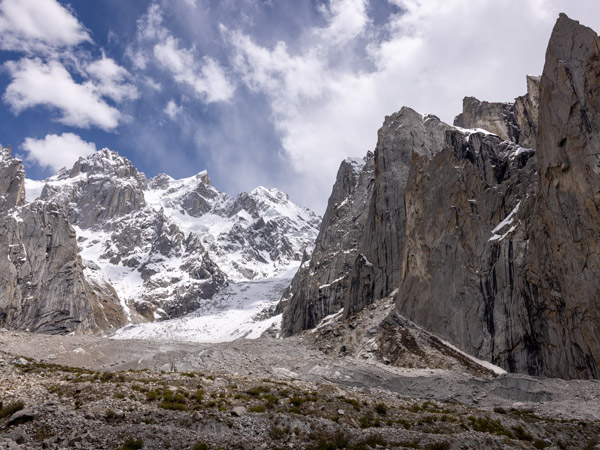
the Karakoram Range, Nangma Valley
The Nangma Valley is ringed by the Karakoram Range. (Image: Intrepid Travel/Patrick O’Neill)

Those mountains are the reason I’m visiting Gilgit-Baltistan. Once referred to as Little Tibet, this land of narrow valleys, seething rivers and vertigo-inducing peaks covers almost 10 per cent of Pakistan’s landmass but accounts for just 0.5 per cent of the population. Ringed by Afghanistan, China and the disputed India border, Pakistan’s northernmost territory is home to some of the largest glaciers outside the polar regions and boasts five summits above 8000 metres (including K2, the world’s second highest). And in a place that demands superlatives, the most eye-catching statistic of all might be the region’s average elevation of 3350 metres. Despite this abundance of natural riches, Gilgit-Baltistan sees few international visitors – in 2023, just over 10,000 foreign tourists visited the region.
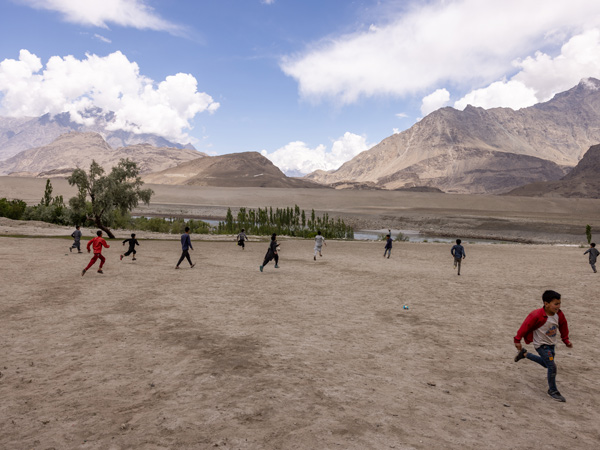
the second highest desert in the world
This region is the second-highest desert in the world. (Image: Intrepid Travel/Patrick O’Neill)

The snow decorating many of the taller pinnacles belies the fact that “this is a desert – the second highest desert in the world," Umer tells me. Skardu is an oasis in this arid land, and it’s also the starting point for expeditions tackling some of the world’s highest peaks.
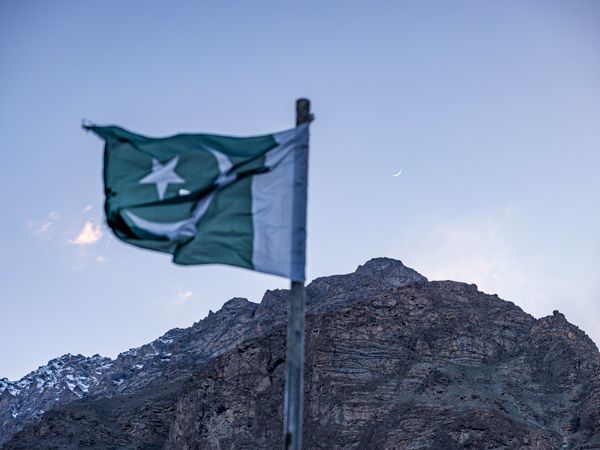
The Pakistani flag with the crescent moon
The Pakistani flag is decorated with a crescent moon. (Image: Intrepid Travel/Patrick O’Neill)

As a result, groups of wizened men clad in flowing salwar kameezes and traditional woven caps gather in a bazaar, where butchers and grocers are joined by stalls selling alpine sleeping bags, crampons and climbing axes.
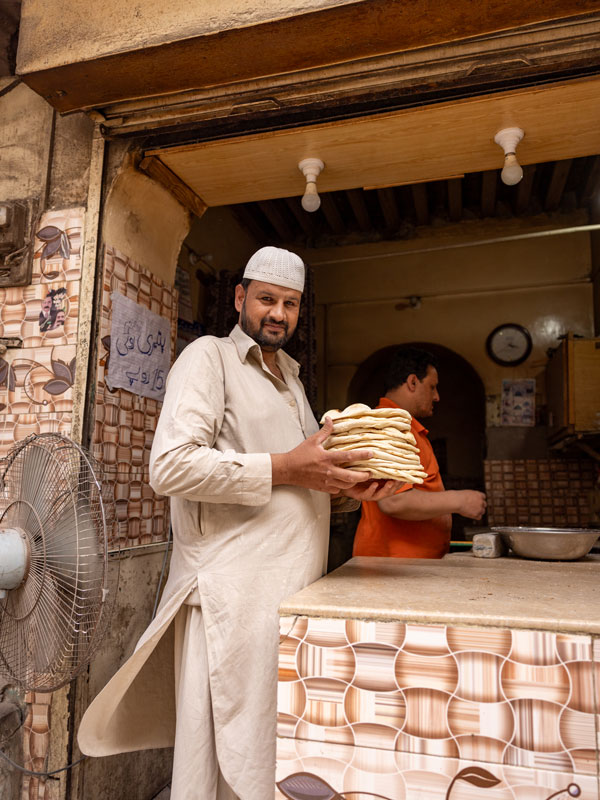
a Pakistani local wearing a salwar kameez
A local wearing a salwar kameez. (Image: Intrepid Travel/Patrick O’Neill)

Fortunately, our journey requires no such specialist equipment. A remote spot blessed with great natural beauty, the Nangma Valley also has the advantage of being accessible to anyone with a decent level of fitness.
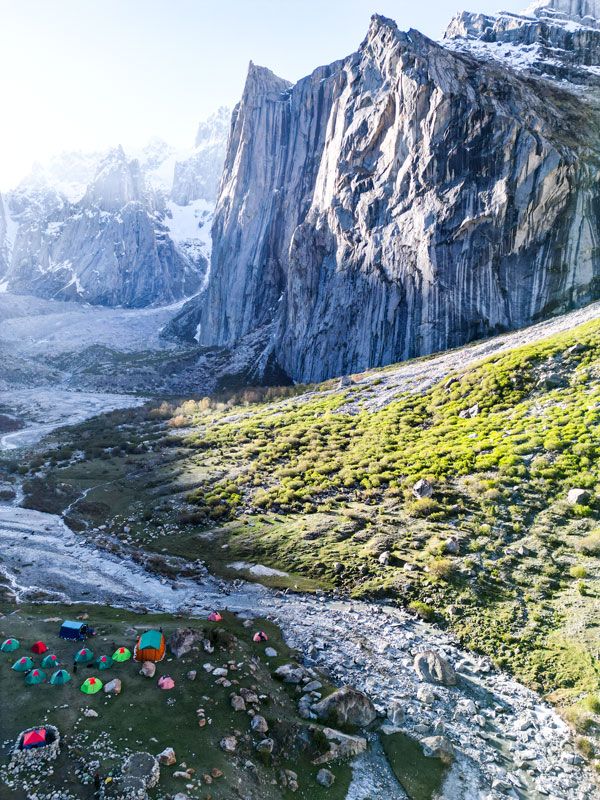
the Nangma Valley, Pakistan
The colourful camp used by Intrepid Travel, at the head of the Nangma Valley, is dwarfed by the surrounding mountains. (Image: Intrepid Travel/Patrick O’Neill)

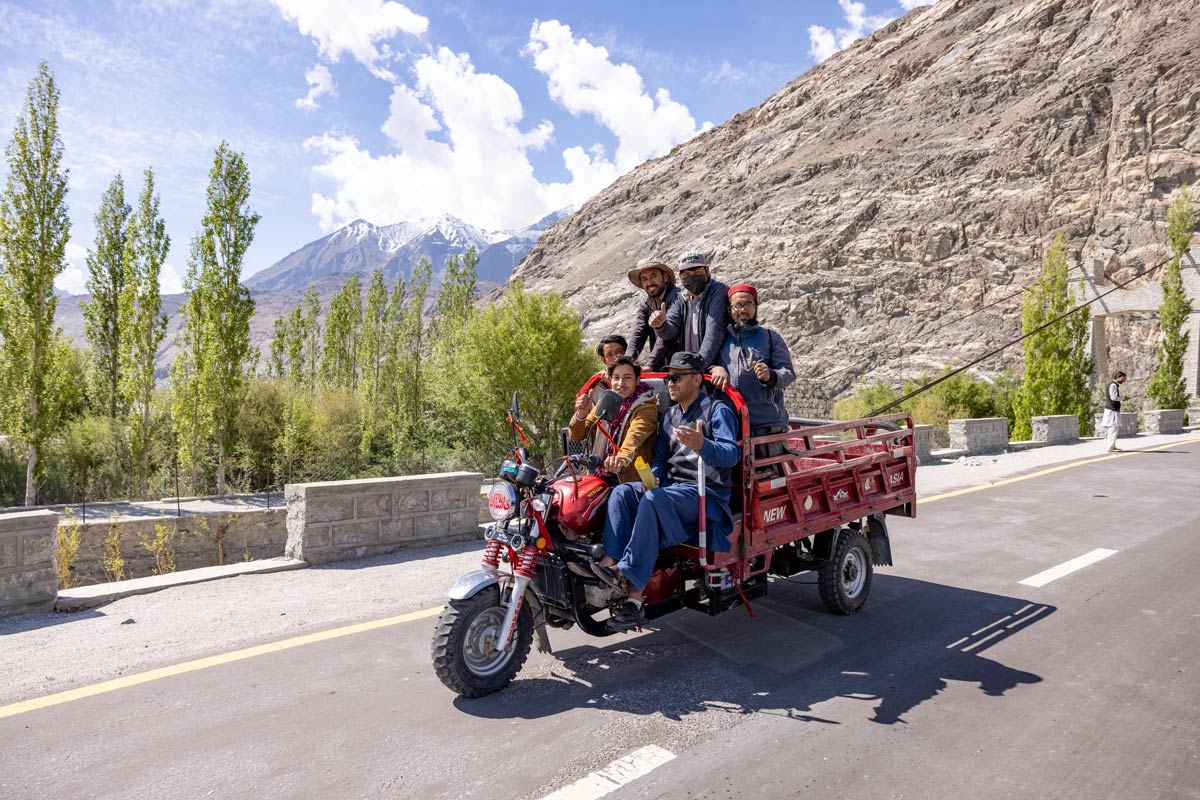
From Skardu, a caravan of Toyota Prados transports our group of 10 along a narrow valley carved by the powerful Indus River. “Baltistan is like a time machine in terms of culture and landscape," Umer tells me as we pass through a village where troops of smiling kids run alongside our convoy. “When you visit this region, you will find a lot of people whose entire world is their valley."
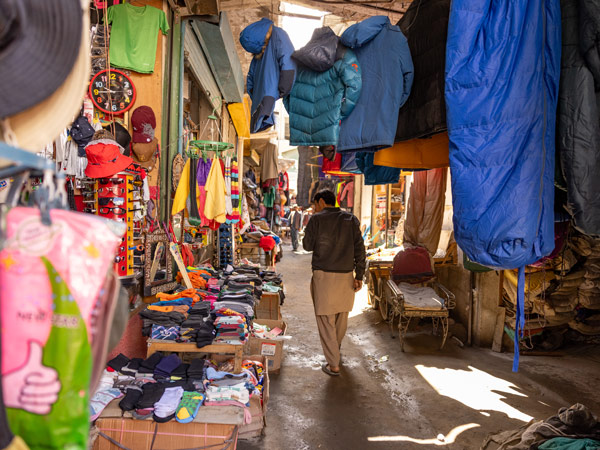
mountaineering gear for sale at the bazaar in Skardu
Mountaineering gear fills the bazaar at Skardu. (Image: Intrepid Travel/Patrick O’Neill)

We get a taste of this in the village of Yugo as we walk through painstakingly terraced fields of bright green barley and see the stone mill used to grind the grain.
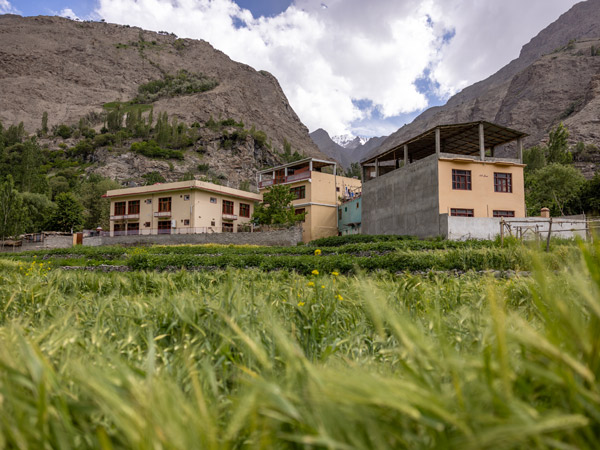
the fields around Yugo
The fields around Yugo contrast starkly with the surrounding countryside. (Image: Intrepid Travel/Patrick O’Neill)

After stopping in a lush orchard to feast on juicy cherries and sweet mulberries plucked from the surrounding trees, we navigate the labyrinthine passages between stone dwellings that provide housing for both people and livestock on our way to a traditional Balti lunch.
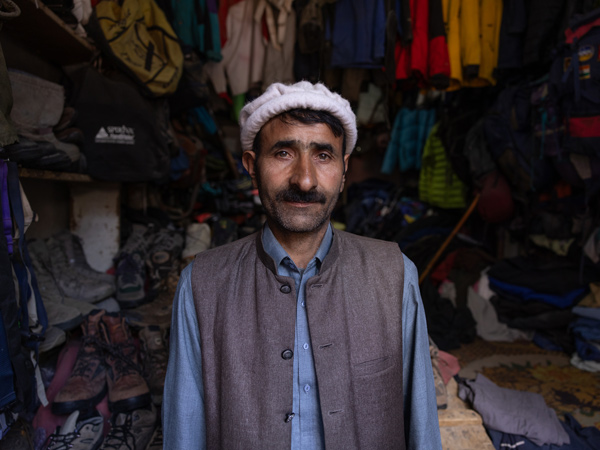
a stallholder in Skardu
Many of the stallholders in Skardu are accomplished mountaineers. (Image: Intrepid Travel/Patrick O’Neill)

Our final stop before we set out on foot is the village of Kanday, where a rapturous reception awaits us. The local men, who have traditionally worked as porters on potentially hazardous K2 expeditions that last for up to three weeks, are thrilled at the prospect of a four-day trek in a destination they can see from their homes.
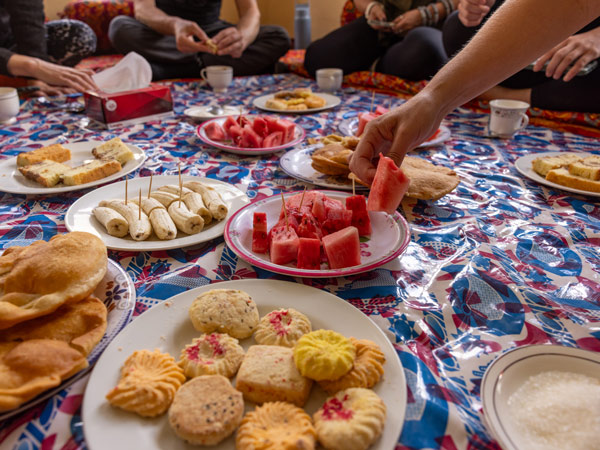
a feast in Kanday
A feast awaits in Kanday at the conclusion of the hike. (Image: Intrepid Travel/Patrick O’Neill)

Once we enter the Nangma Valley, it rapidly narrows until only a few hundred metres separate the near vertical walls on either side. The occasional waterfalls that cascade down these sheer cliffs dissolve into mist long before they hit the ground and in many spots the trail is so steep that it blocks out the path ahead.

the Karakoram Range, Nangma Valley
The Nangma Valley is ringed by the Karakoram Range. (Image: Intrepid Travel/Patrick O’Neill)

When it does flatten out, we’re treated to glimpses of jagged shards dusted in white, looming above immense rock faces that are so steep no snow can settle on them.
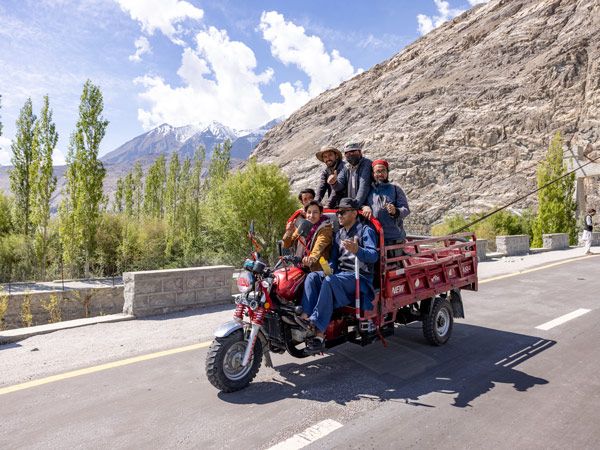
locals greeting the group on the way to the Hushe Valley
Locals greet the group’s convoy as they travel up the Hushe Valley. (Image: Intrepid Travel/Patrick O’Neill)

Occasionally we pass small clearings with mulberry trees whose broad boughs provide welcome shade and dry rock shelters that are still used by local shepherds. But it’s not until we reach our campsite that we find a flat spot broad enough to accommodate more than a few tents. Our local support team has also made note of the space; after a welcome cup of tea, a grinning porter appears with a cricket bat and a makeshift wicket.
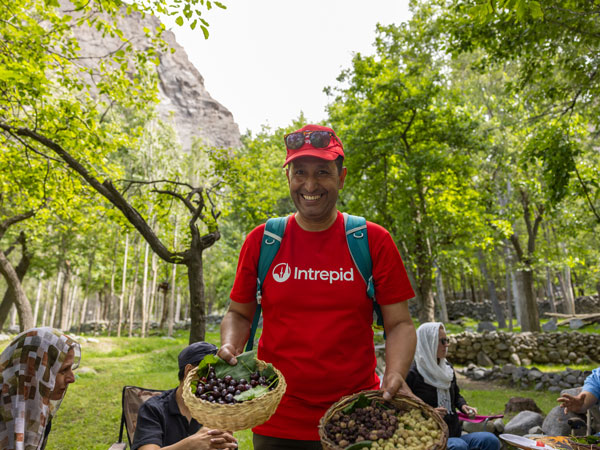
Guide Muneer Alam holding freshly picked cherries and mulberries
Guide Muneer Alam showing off freshly picked cherries and mulberries. (Image: Intrepid Travel/Patrick O’Neill)

What begins as a friendly hit soon acquires a competitive edge as lead guide Muneer Alam shows how he acquired the unlikely nickname of Courtney Walsh. The 48-year-old from the nearby Hunza Valley is prone to endearing fits of giggling and flashes a broad grin as he addresses us over dinner. “You did a great job today," he encourages us. “But this is just the starter; you still have the main course and dessert to come."
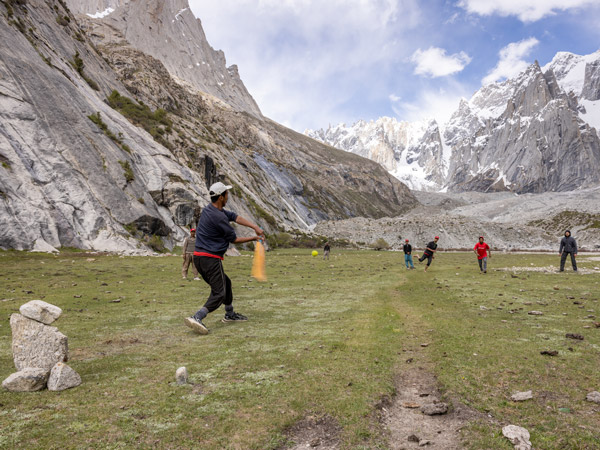
the porter showing their cricketing prowess
The porters don’t need any encouragement to show off their cricketing prowess. (Image: Intrepid Travel/Patrick O’Neill)

The second day of hiking takes us around a slight bend in the valley until the mountains surrounding us seem less like a collection of individual peaks than an unbroken wall of jagged stone. Muneer identifies one especially forbidding sheet of rock as Amanat Brakk, a 5400-metre monster that was climbed for the first time in 2022. Our path follows a powerful glacial stream and after ascending through boulder fields of white granite we reach our main campsite, which doubles as the starting point for the final climb to Amin Brakk base camp at 4500 metres.

That day-long walk begins with a steep climb that provides a lesson in perspective, our tents rapidly receding into red and green dots that are dwarfed by the monumental peaks on every side. When Muneer stops and announces, “This is a good photo spot," it’s hard to see what sets it apart from any other point on the trail. There’s barely a bad view on the entire hike, which is just three kilometres each way but ascends 570 lung-busting metres.
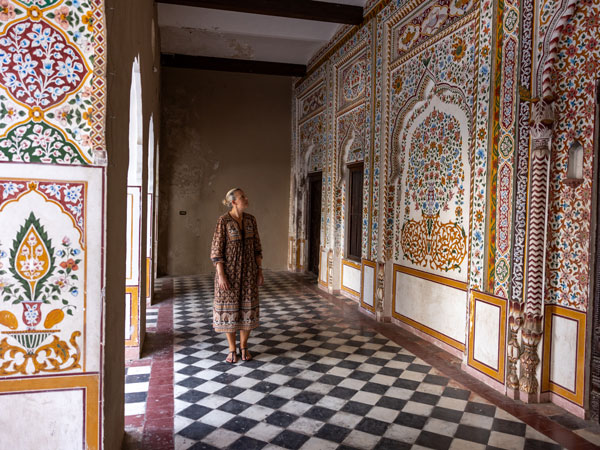
a woman exploring Hindu Dharamsala in Saidpur
The Hindu Dharamsala in Saidpur. (Image: Intrepid Travel/Patrick O’Neill)

An enormous bag of local scroggin stuffed with tart apricots, sweet dried mulberries and walnuts helps keep my energy levels up as we walk between magnificent pointed peaks dusted in snow and cross sloping meadows split by a stream that thunders down to the valley. “This is the best picnic spot I’ve ever seen," declares a fellow trekker named Erica when we stop for lunch. Ben, an avid hiker from the UK, goes one step further. “I don’t think I’ve ever been this happy!"

My highlight comes further up the trail, after a steep climb reveals our final destination. A stupendous granite column stretches more than 1500 metres into the sky, dwarfing us with its sheer size. Though it looks impossible to climb, Umer tells me that several groups have succeeded – after spending up to a month on the rock face.
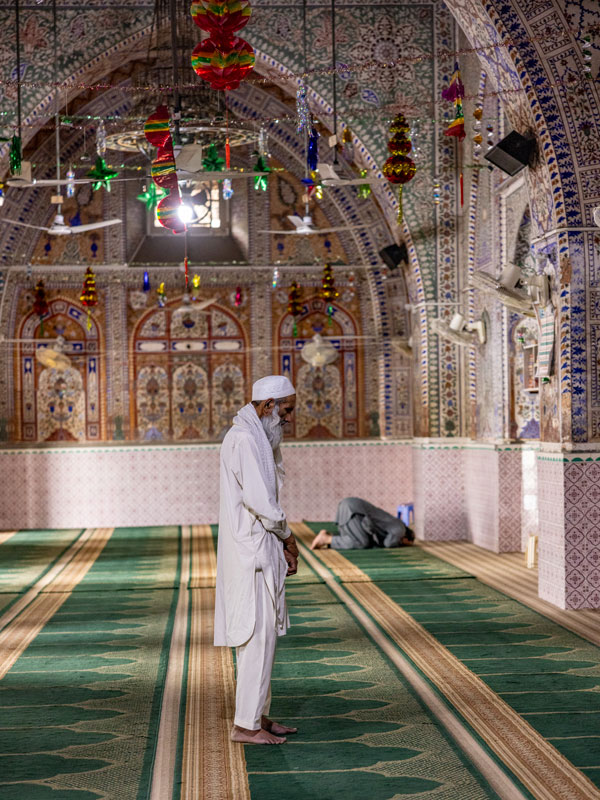
a man praying inside Markazi Jamia Mosque
A man praying in Rawalpindi’s Markazi Jamia Mosque. (Image: Intrepid Travel/Patrick O’Neill)

For me, it’s enough to have made it to the base of this formidable cliff, which looks across to another equally intimidating wall of rock. Between them lies an even taller summit buried beneath a large glacier, while in the other direction, a string of pointed crags resembling serrated incisors directs my view back to the mountains that have kept me company for the past few days. It’s an utterly wild vista, and in my decades of hiking, I’ve never seen anything approaching this agglomeration of magnificent peaks.

After almost a week in this wild, seemingly untouched landscape, it’s a shock to return to Islamabad. Pakistan’s capital is a planned city with grids of wide boulevards and a surprising amount of greenery, but there’s also a lively side to the city of 1 million people.
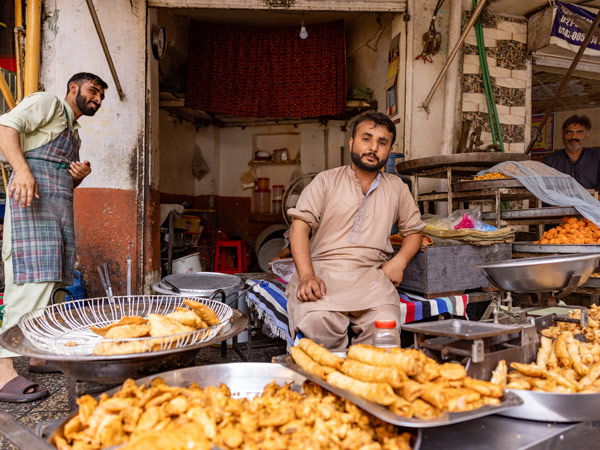
a street food vendor in Rawalpindi
A stallholder in Rawalpindi. (Image: Intrepid Travel/Patrick O’Neill)

A celebratory mood overtakes our group as we feast on street food such as spice-laden papri chaat and visit museums that explain how local civilisations were shaped by Persian, Indian, Chinese, Central Asian and even Greek influences.
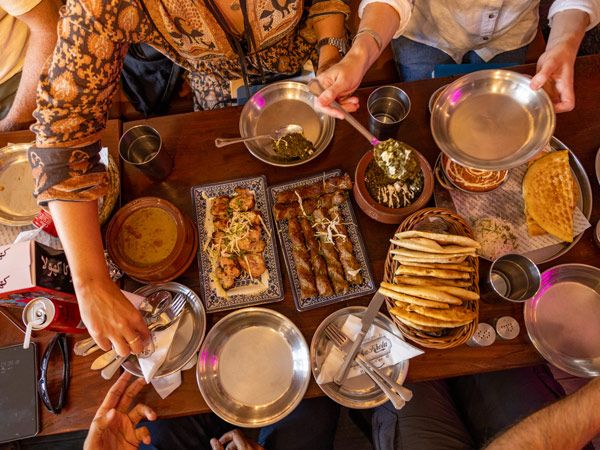
a Pakistani feast
Sitting down to a Pakistani feast. (Image: Intrepid Travel/Patrick O’Neill)

In nearby Taxila, we see a more contemporary expression of Pakistani culture at a workshop, where artisans turn trucks into works of art by covering every available surface (down to the fuel caps) in brightly coloured paintings, stickers and mosaics.
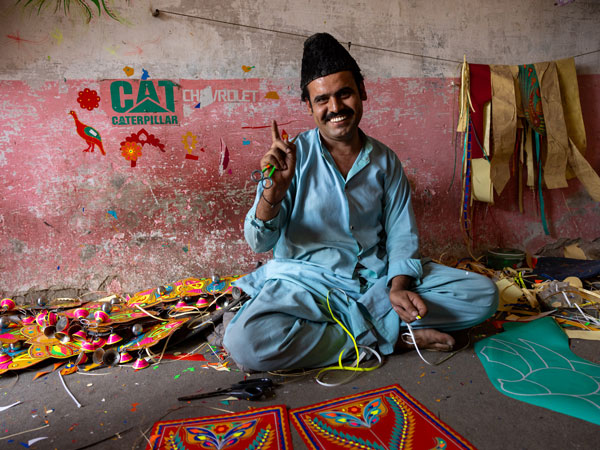
a worker making truck decor, Taxila
A worker making truck decorations in Taxila. (Image: Intrepid Travel/Patrick O’Neill)

After watching the moon rise from the vast courtyard of the world’s fifth-largest mosque, we head to an Afghan restaurant and tear into lamb skewers glistening with fat, bowls of decadently soft braised eggplant and rice flecked with carrots and sultanas.
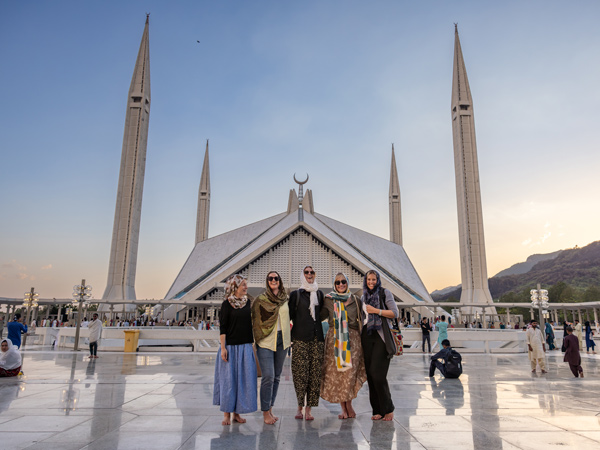
a group of travellers posing in front Islamabad’s Faisal Mosque
Islamabad’s Faisal Mosque is the fifth largest in the world. (Image: Intrepid Travel/Patrick O’Neill)

In a rare break between bites, Umer turns to me and exclaims, “I’m 35 and I have never been to a function where all the food is finished. We Pakistanis are so afraid of seeing an empty plate!".
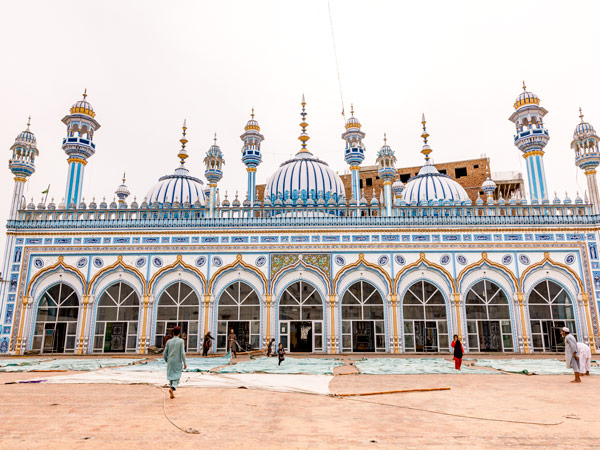
Markazi Jamia Mosque in Rawalpindi
The elaborately decorated Markazi Jamia Mosque in Rawalpindi. (Image: Intrepid Travel/Patrick O’Neill)

A traveller’s checklist

Getting there

It’s possible to fly from most Australian cities to Islamabad with a single stopover on Qatar Airways, Etihad or Emirates.

Playing there

Intrepid’s 10-day Trek Pakistan’s Karakoram Mountains tour runs once a month between May and September. It includes six nights’ accommodation in a hotel and three nights’ camping, all meals, guided hikes and other various activities such as a Yugo village cultural walk and a live music and dance show by local Balti people. From $4770 per person.
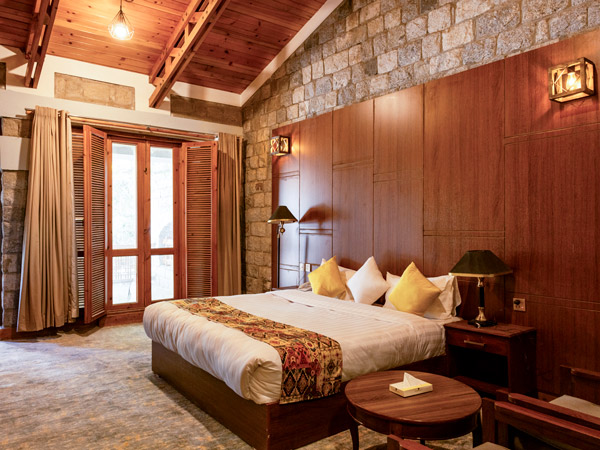
a hotel accommodation in Pakistan
Comfort awaits after the trek. (Image: Intrepid Travel/Patrick O’Neill)

Need to know

Intrepid can provide the Letter of Introduction you’ll need when you apply for an e-visa, which can be obtained online for $90.

Want to see more stories from International Traveller in your Google search results?

  1. Click here to set International Traveller as a preferred source.
  2. Tick the box next to "International Traveller". That's it.
Alexis Buxton-Collins
Alexis Buxton-Collins spent his twenties working as a music journalist and beer taster before somehow landing an even dreamier job as a freelance travel writer. Now he travels the world from his base in Adelaide and contributes to publications including Qantas, Escape, The Guardian and Lonely Planet. Alexis has never seen a hill he didn't want to climb and specialises in outdoor adventures (he won the 2022 ASTW award for best nature/wildlife story for a feature on Kangaroo Island). When he's not scouring South Australia for the newest wineries and hikes, he's looking for excuses to get back to spots like Karijini and Ningaloo.
View profile and articles
hero media

5 things every hotel needs for a more restorative stay

    Kate Bettes Kate Bettes
    Wellbeing means different things to different travellers. Here’s how to pick a hotel that gets it right for you.

    The best wellness holidays aren’t necessarily spent wrapped in a spa robe. Sometimes they’re found around a dinner table in Cambodia, on a hiking trail in New Zealand or after finally beating jet lag on the other side of the world. The hotel you choose is what makes them happen.

    1. Easy access to good food

    meals from Novotel Bangkok Sukhumvit 20
    Taste delicious meals at Novotel Bangkok Sukhumvit 20.

    One of the quickest ways to derail healthy habits on holiday is to spend half of it working out where to eat instead of digging into the culture around you. Thankfully, Novotel has done much of the hard work already, with chefs building menus that lean into the flavours, ingredients and traditions of each destination.

    In Sihanoukville, Cambodia, Korkor soup – often dubbed ‘Cambodian ratatouille’ – sits alongside raw blue crab dressed with lime and chilli, best enjoyed with views across the Gulf of Thailand.

    In the lovingly chaotic city of Bangkok, the presence of food cranks up the sociability. At Novotel Bangkok Sukhumvit 20, you can settle in with mango sticky rice and stranger-turned-friends beside the pool at Sky on 20 rooftop bar, or bring them along to tackle river prawns and stir-fried crab with holy basil at the buzzing Crab Paradise Dinner Buffet.

    Then Novotel Dubai Al Barsha welcomes you with a laidback twist on the level of indulgence the Middle Eastern city is best known for up on Deck Se7en. Looking towards Burj Al Arab, the rooftop lounge has everything from Mediterranean-style dishes like seabass ceviche to Italian prosecco sundowners.

    At the other end of the scale, in the hills that surround the Novotel Bali Ubud Resort, calm comes from nature. At Siralada restaurant, Balinese traditions shape the menu while thunder rumbles over the surrounding jungle – proving the setting is as nourishing as the food itself.

    While at Novotel Nha Trang, chef Kieu Thi My Hanh and her team showcase Vietnam’s knack for balancing freshness, texture and fragrant herbs. Pho remains a favourite, while seafood salad with pomelo and mango brings those flavours together in one bright dish.

    It’s all an approach backed by partnerships with expert food creators such as Alfie Steiner, whose plant-forward recipes prove healthy food should never taste plain.

    2. Better sleep options

    Novotel Bali Ubud Resort room
    Sleep deeply with Novotel.

    There are few travel experiences more disappointing than arriving in a new country, determined to seize the day, only to fall asleep fully clothed by 3pm.

    For Australian travellers, jet lag is often an unavoidable part of the journey. That’s one reason Novotel runs sleep-focused initiatives that help guests adjust quickly without compromising on health. We’re talking partnerships with Sydney-based sleep specialist Olivia Arezzolo, known for her advice on everything from better sleep habits to beating jet lag, alongside features like pillow menus, in-room yoga content and tailored sleep guidance.

    The sooner you’re operating on local time, the sooner you can get back to more pressing matters – like deciding which spa treatment to book.

    3. More ways to move

    woman hiking around queenstown new zealand
    Stay at Novotel Queenstown Lakeside and explore local hiking trails. (Credit: GettyI mages/ naruedom)

    Every place in the world has its own way of getting you moving: whether that’s hiking up ice-bitten mountains before a sauna or gentle stretching by the pool before a facial. From fitness centres to spas, Novotel recognises that wellbeing rarely looks the same.

    At Novotel Queenstown Lakeside, activity is inescapable. Here, hiking trails, ski fields, bungee jumps, and white-water rafting have made the region famous. The hotel’s location on the shores of Lake Wakatipu means less time spent organising yourself and more time out there experiencing them. To top it all off, you can book a private hot tub for the evening before heading back into the wilderness tomorrow.

    Bali, of course, takes a softer approach. At Novotel Bali Ubud Resort or Novotel Bali Nusa Dua, movement is less about conquering a mountain and more about a dance class between the tropical gardens and lagoon pools. Afterwards, the spa takes over, with traditional treatments like a Lulur body scrub: a combination of rice, turmeric, sandalwood, ginger and jasmine that’ll soothe muscles already relaxed by the Balinese heat.

    4. Better connections

    Novotel Sharm El Sheikh
    Kids will love a stay at Novotel Sharm El Sheikh.

    One of the best things about travel is that it gives your family stories you’ll be telling for years. Novotel helps create them with activities that bring everyone together, whether that’s trying something new, learning a local skill, or simply spending more time together.

    Go for a distinctly Thai twist at Novotel Phuket Vintage Park, where many of the family activities draw on local culture. Kids can try everything from beginner Thai boxing and language lessons to umbrella painting and – a pastime beloved by children the world over – pool foam parties. Everyone is welcome to join in, whether that’s getting splashed, covered in paint, or simply watching their children discover a new side of Thailand during the dedicated Family & Kids Day.

    A different adventure awaits at Novotel Sharm El Sheikh. Kids could be perfectly content with discos, drawing classes and new holiday friends, but the Red Sea has other ideas. Sitting on the edge of Naama Bay, days here might involve snorkelling colourful reefs, taking a boat trip to Ras Mohammed National Park or heading into the desert by quad bike or camel for a Bedouin-style dinner beneath the stars.

    5. Location is everything

    Surin Beach, Choeng Thale, Thalang District, Phuket, Thaiföld
    Explore Phuket’s gorgeous beaches. (Credit: Bence Biczo)

    Everyone’s idea of wellness looks a little different. With more than 600 hotels across 65 countries, Novotel gives guests the freedom to choose the destination that suits them best. Whether that’s a beachside escape in Phuket, an alpine expedition in Queenstown or a city break in Bangkok, there’s a good chance a Novotel isn’t far away.

    All that’s left? Choosing your version of wellbeing.

    Discover stays to inspire your everyday at novotel.accor.com.